Railnews from Railfan & Railroad Magazine


NC&StL 576 Fired Up For First Time in 74 Years
The Nashville Steam Preservation Society, the non-profit restoring Nashville, Chattanooga & St. Louis Railway 4-8-4 576, has fired up the locomotive for the first time since 1952. The group conducted a steam test this week, and by all accounts, it was a success.
The Nashville Steam Preservation Society has been restoring NC&StL 576 at the Tennessee Central Railroad Museum since 2019. The locomotive was one of 20 J3 4-8-4s built by Alco for the NC&StL in 1942 and 1943. After it was retired, it was displayed in a Nashville park.
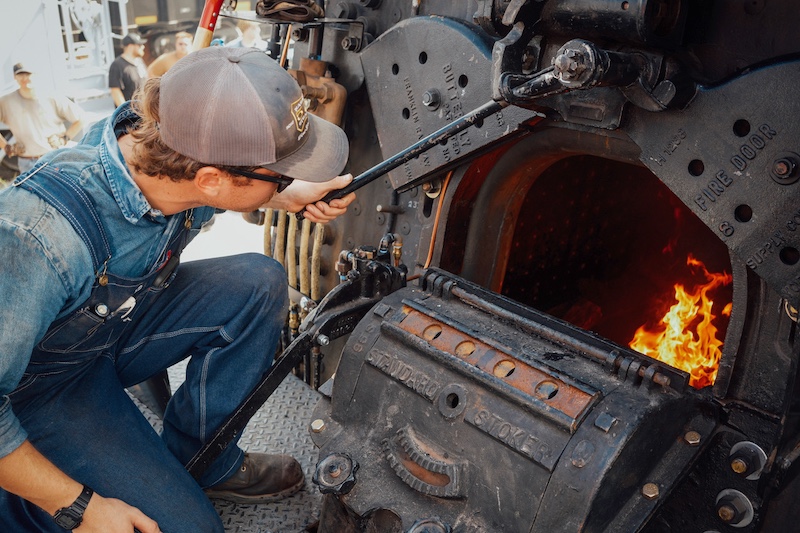
Photo Courtesy of FMW Solutions.
“From the moment No. 576 was placed in Centennial Park and the rails were removed behind it, generations of Nashville citizens dreamed of seeing it steam again,” said NSPS President Shane Meador. “When our organization was formed in 2016, that dream became our mission.”
Officials said they expect the locomotive to run in 2027.
For more information, visit www.nashvillesteam.org.
—Justin Franz
The post NC&StL 576 Fired Up For First Time in 74 Years appeared first on Railfan & Railroad Magazine.
Semiquincentennial Rolling Stock Keeps Rolling In
Even as the Independence Day holiday wound down, several railroads were still showcasing Semiquincentennial rolling stock – including cabooses and freight cars.
The narrow-gauge East Broad Top Railroad rolled out caboose 27, painted in red, white, and blue, which took inspiration from the former nearby coal hauler Pittsburg & Shawmut Railroad. It entered service on July 3 and is expected to remain in America 250 colors through next season, when it will return to its original red scheme.
Built in East Broad Top’s shops in 1920, the caboose received thorough documentation and restoration, including replacement of exterior siding, a new roof, trim, and windows, the railroad said. Much of the work took place over the winter.
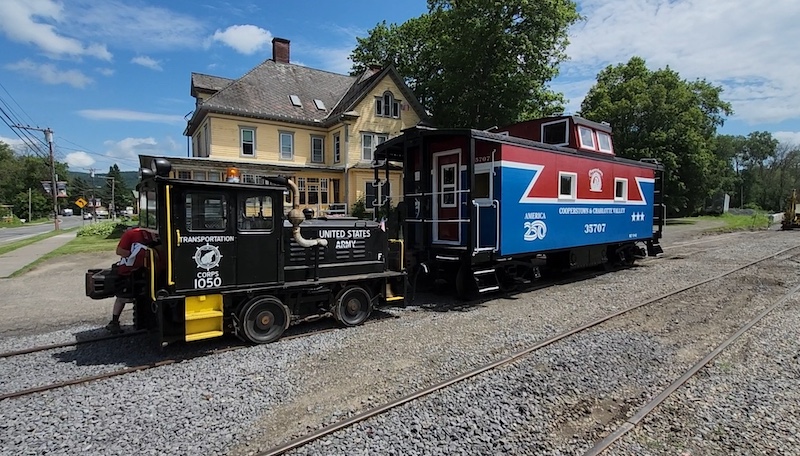
Photo Courtesy of Cooperstown & Charlotte Valley.
Tourist carrier Cooperstown & Charlotte Valley in New York painted Delaware & Hudson caboose 35707 red, white and blue as well. It started life as a boxcar and was rebuilt into a caboose in October 1942. To save on metal for the war effort, it was sheathed with wood instead of steel, the railroad said. With a stronger-than-typical frame, this caboose was in service where pushers were often used.
And not to be outdone, Union Tank Car UTLX 1776 was built in Louisiana in June and will tour the company’s eight facilities this year. It was on display at Union Tank Car’s Altoona, Pa. plant in July – the same time Union Pacific 4-8-8-4 number 4014 was in town.
“Built entirely in Alexandria, La., the railcar honors America’s manufacturing heritage and the skilled workers who continue to build critical transportation infrastructure in the United States,” the company said.
—Michael T. Burkhart
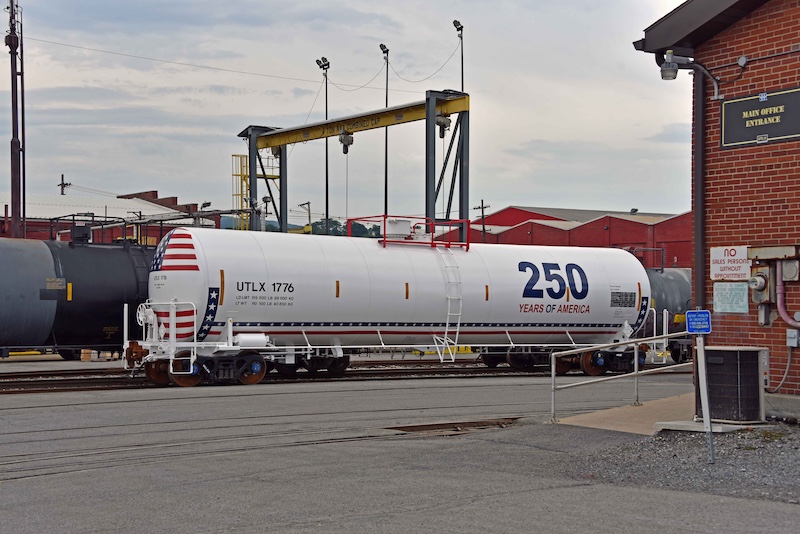
Photo by Michael T. Burkhart
The post Semiquincentennial Rolling Stock Keeps Rolling In appeared first on Railfan & Railroad Magazine.
NRHS Awards $187,000 in Preservation Grants
The National Railway Historical Society recently awarded $187,000 in grants to 34 railroad preservation organizations across the United States. The grand program was established by the NRHS to help railway history efforts and this year received 46 applications requesting more $330,000 in funding.
“On behalf of the NRHS, the Board of Directors, and myself, I extend sincere appreciation to the Heritage Grants Committee for its steadfast commitment to the mission of the NRHS and to preserving railroad history,” White said. “We also gratefully acknowledge our members, whose donations help sustain this important program. We encourage all applicants to continue their efforts to preserve and share our nation’s rail heritage.”
The winners include…
Center for Railroad Photography & Art, Madison, WI: $10,000 towards digital preservation program. This award is in honor of George Hickok, long-term member of the NRHS Heritage Grants Committee and IT professional.
Virginia Museum of Transportation, Roanoke, VA: $10,000 towards N&W Class J #611 stoker repairs. This award is in memory of Carl Jensen, a long-term member of the NRHS Heritage Grants Committee
Friends of the Cumbres & Toltec Scenic Railroad, Albuquerque, NM: $10,000 towards restoration of Denver & Rio Grande narrow gauge Baggage Express Car 163
Burkburnett Historical Society, Burkburnett, TX: $8,000 towards repair of Missouri-Kansas-Texas Railroad depot
Harrisburg Chapter., NRHS, Harrisburg, PA: $7,500 towards repair and/or historic replacement of windows at Harris Tower
Forney Museum of Transportation, Denver, CO: $7,500 towards restoration interior, electric and lighting of Pullman Moffat Coach #1906
Moffat Road Railroad Museum Assoc., Granby, CO: $7,500 towards restoration of Dumont Depot
Galloping Goose Historical Society, Delores, CO: $7,500 towards restoration of Denver, Rio Grande &Western refrigerator Car #45
DeLeon Area Historical Society, DeLeon, TX: $7,000 toward the restoration of the DeLeon Depot windows.
Mt. Airy Museum of Regional History, Mt. Airy, NC: $6,000 towards outdoor exhibit for NC Granite Corp locomotive “Captain Jack” at their museum
Niagara Frontier Chpt., NRHS, Tonawanda, NY: $5,000 towards repairs of GE 25T Standard Elevator locomotive #1
West Jersey Chpt., NRHS, Palmyra, NJ: $5,000 towards creation of Camden & Amboy Railroad Historical District in Bordentown NJ
Baltimore Streetcar Museum Inc., Baltimore, MD: $5,000 towards fence around Maryland & Pennsylvania Railroad Freight Depot
Wichita Falls Railroad Museum, Wichita Falls, TX: $5,000 towards renovation of Chicago, Burlington & Quincy Railroad power coach number 7203
TOYX Inc., Dingmans Ferry, NY: $5,000 towards restoration of Erie cabooses in Port Jervis, NY
Lewes Junction Railroad & Bridge Assoc., Lewes DE, $5,000 towards refurbishment and placement of Pennsylvania Railroad locomotive B6sa # 60
Conrail Historical Society, Inc., Wallington, PA: $5,000 towards renovation of Conrail caboose # 21292
Oregon Depot Museum, Oregon, IL: $5,000 towards restoration and reupholstering of Chicago, Burlington & Quincy Railroad Silver View dome car
Colorado Model Railroad Museum, Greeley, CO: $5,000 towards restoration of Rock Island Railroad caboose 17017
Mid-Continent Railway Museum, North Freedom, WI: $5,000 towards restoration of Lake Superior & Ishpeming Railroad coach 64
Western American Railroad Museum Systems, Barstow, CA: $5,000 towards security enhancements
Minnesota Transportation Museum, St. Paul, MN: $5,000 towards restoration of the James J. Hill Manitoba Car
Major County Historical Society, Fairview, OK: $5,000 towards repair of Kansas City, Mexico & Orient Railway Depot
Museum Inc, dba The Heritage Museum, Libby, MT: $5,000 towards costs to move Shay 4 locomotive
Yakima Valley Trolleys, Yakima, WA: $4,900 towards restoration of YVT Brill Master Unit 12
Gordon – Westcott Historical Society, Gordon, WI: $4,000 towards moving Soo Line caboose 82
Mineral Point Historical Society, Mineral Point, WI: $4,000 towards restoration of railroad baggage and freight carts
North Carolina Railway Museum, New Hill, NC: $4,000 towards creation of Pullman history exhibit
Wayne Historical Preservation Society, Wayne, IL: $4,000 towards new windows in the Wayne Depot
Wilson Brewer Park Depot and Museum, Webster City, IA: $4,000 towards restoration of Illinois Central caboose
Friends of the New York Central Railroad Museum, Elkhart, IN: $3,600 towards restoration of NYC caboose #19211
Museum of Western Colorado, Grand Junction, CO: $2,500 towards restoration of Whiskey Creek Trestle
National Museum of Transportation, St. Louis, MO: $2,500 towards restoration of Monsanto tank car 117
Denver South Park & Pacific Historical Society, Denver CO: $2,500 towards recreation of South Park Zephyr rail car
The post NRHS Awards $187,000 in Preservation Grants appeared first on Railfan & Railroad Magazine.
Steam Returns to Summit of Mt. Washington
After a year-long absence, steam has returned to the summit of the Northeast’s tallest peak.
Earlier this summer, New Hampshire’s Mt. Washington Cog Railway completed a rebuild of 0-2-2-0 No. 9, and after a series of test runs in early July, it entered regular service on July 10. The biggest aspect of the recent overhaul was a brand-new boiler built by Maine Locomotive & Machine Works in Alna, Maine.
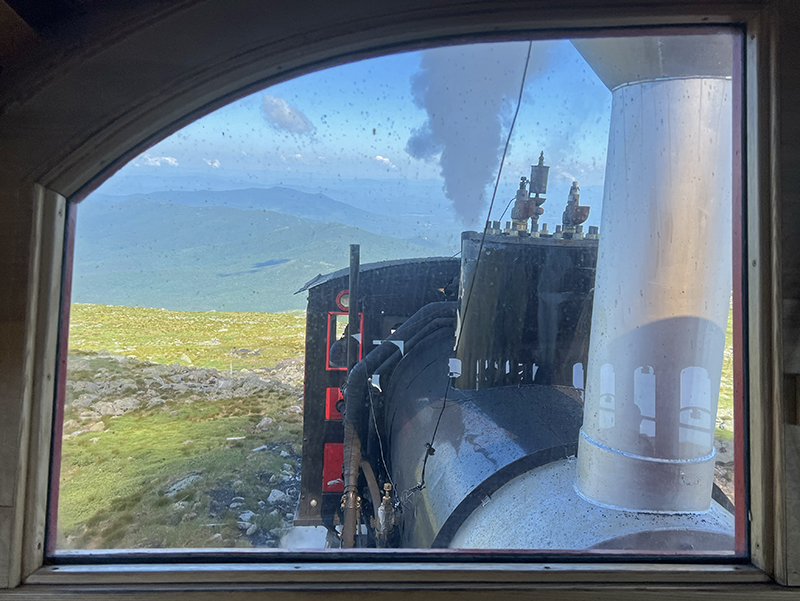
Mt. Washington Cog Railway 9 is seen pushing the second regular steam run of the 2026 season up the Northeast’s tallest peak on July 11. Photo by John House.
Constructed in the 1860s, the Mt. Washington Cog Railway was the world’s first mountain-climbing cog railroad. From 1869 until 2008, steam ruled the west slope of Mt. Washington. However, in the late 2000s, diesel locomotives began to replace most steam locomotives. Presently, there are two steam engines on the active roster: Locomotive 2, the Ammonoosuc, built in 1875, and locomotive 9, the Waumbek, built in 1908. Both locomotives were constructed by the Manchester Locomotive Works, which later became part of the American Locomotive Company.
In recent years, the steam engines have generally been used on the first train of the day during the summer and fall. But last year, during pre-season preparations, it was determined that neither locomotive could be operated at full pressure until additional repairs were made. In August, locomotive 9 was put back in service, but only for runs halfway up the mountain. Over the winter, the Cog received two new boilers from Maine Locomotive & Machine and installed the first atop 9’s frame earlier this year. With the locomotive back in service, the railroad plans on operating steam on Thursdays, Fridays, Saturdays, and Sundays at 9 a.m. and 2:45 p.m. through the summer and fall. Locomotive 2 is expected to be restored soon as well, ensuring that steam will continue to push trains up Mt. Washington for decades to come.
—Justin Franz
The post Steam Returns to Summit of Mt. Washington appeared first on Railfan & Railroad Magazine.
Wilmington & Western Joins Semiquincentennial Celebration
Delaware tourist carrier Wilmington & Western Railroad rolled out its Semiquincentennial locomotive – SW-1 1776 – on July 4, for one of the largest fireworks displays in the region. It’s perhaps the oldest diesel to wear an “America 250” livery.
Built by EMC in 1940 as Lehigh Valley Railroad 114, it served the Maryland Port Authority and short-lived tourist operator Ocean City Western Railroad before coming to the W&W (also as number 114) in the 1980s. It works alongside former Baltimore & Ohio SW-1 8408.
Locomotive 1776 debuted on the annual and popular “Fireworks Express” to Hockessin, Del. on the evening of July 4. It ran in regular service out of Greenbank, Del. on July 5, but a mechanical issue sidelined it late in the day.
The W&W was established in 1966 to operate excursions on 10 miles of former Baltimore & Ohio trackage between Greenbank and Hockessin, Del.
—Michael T. Burkhart
The post Wilmington & Western Joins Semiquincentennial Celebration appeared first on Railfan & Railroad Magazine.
Combined UP, NS Looks to Divest From Terminal Railroads
Union Pacific and Norfolk Southern would try to sell some of their ownership stakes in the Terminal Railroad Association of St. Louis, Kansas City Terminal Railway and TTX Company if their merger is approved, according to new filings with the U.S. Surface Transportation Board.
In May, the federal regulator tentatively accepted UP’s application to acquire NS, but requested additional information about a number of topics. On July 7, UP and NS filed the first portion of that request with information about how they would handle companies that they jointly own with other Class Is. The primary railroads in question include TRRA in St. Louis, which they jointly own with BNSF Railway, CSX and Canadian National, and KCT, which is owned with BNSF and CPKC.
In the revised filing, UP and NS officials accused the other Class Is of using the terminal railroads as pawns in their effort to delay the proposed merger, one that would create a 50,000-mile rail system across 43 states. For example, UP called a meeting of the TRRA board to discuss how the joint ownership of the railroad would be handled following a UP-NS merger. But none of the other Class Is showed up to the meeting. UP owns 42.84 percent of TRRA, and NS, BNSF, CSX and CN each own 14.29 percent of the railroad. One solution proposed by UP-NS is to split up NS’s shares among the other railroads so UP would not own more than 50 percent of TRRA. Another suggestion calls for handing over NS’s shares to a new railroad altogether. Similar solutions were suggested for KCT and TTX. TTX, the freight car provider and manager, is jointly owned by the six American Class Is plus Ferromex.
UP and NS said they intend to provide more information about their merger to the STB before a July 27 deadline.
—Justin Franz
The post Combined UP, NS Looks to Divest From Terminal Railroads appeared first on Railfan & Railroad Magazine.
Steamtown 2-6-0 Acquired by New York Museum
Norwood & St. Lawrence 2-6-0 210 has been acquired by the St. Lawrence Power & Equipment Museum in Madrid, N.Y. The engine was previously part of the Steamtown National Historic Site collection but was recently deemed surplus, allowing it to return home to upstate New York.
Built by the American Locomotive Company in 1923, locomotive 210 pulled freight and mixed trains on the Norwood & St. Lawrence Railroad, a subsidiary of the St. Regis Paper Co. The engine was sold to a Watertown, N.Y., scrap yard in 1957, before being purchased by F. Nelson Blount in 1965 for his Steamtown collection in Vermont. Eventually, 210 and the rest of the Steamtown collection moved south to Scranton, Pa., in the late 1980s, becoming the property of the National Park Service. The engine has been stored in the Steamtown yard for years, mostly out of sight.
The locomotive will be cosmetically restored and displayed at the St. Lawrence Power & Equipment Museum. Since 2006, the museum has helped tell the story of the people and industry of New York’s North Country.
—Justin Franz
The post Steamtown 2-6-0 Acquired by New York Museum appeared first on Railfan & Railroad Magazine.
Colebrookdale Railroad Acquires Historic 1909 Pullman Car
The Colebrookdale Railroad in Pennsylvania has acquired a historic Pullman car built in 1909 that, since the 1960s, has been part of a restaurant in New Jersey.
The car was built for Utah mining executive Daniel Cowan Jackling and was named “Cyprus” for a number of years. The car later ended up on the Pittsburgh & West Virginia Railway. In 1967, it was sold to a New Jersey family and for decades was part of The Essex House restaurant in West Orange. The restaurant closed in 2020, and the car was recently put up for sale. The car was moved from New Jersey to the Colebrookdale in June. The Markouris family, who previously owned the car, said they are excited about its future.
“Others reached out to us about this car,” said Tony Markouris, son of the owners, “but it was The Colebrookdale that gave us the confidence that it would be restored and put back in service. We’re proud of the fact that we could preserve it well enough that this will be its end; that we could be the bridge in preserving it between its past and future.”
Railroad officials have said the full restoration could take a few years, but they are confident the car will roll again.
“Passengers will once again be able to ride in this beautiful Victorian car, enjoying a meal just as they would have in days gone by. It’s a reconnection to not only Cyprus’ past, but to our own,” said Nathaniel Guest, founder of the Colebrookdale Railroad Preservation Trust.
The car is unique because it marks the transition from building Pullman cars with wood to building them with steel; the car has a steel frame but the body itself is made of wood.
The Colebrookdale Railroad was established in 2014 and operates excursions on a former Reading Company branch line in southeastern Pennsylvania.
—Justin Franz
The post Colebrookdale Railroad Acquires Historic 1909 Pullman Car appeared first on Railfan & Railroad Magazine.
Mt. Rainier Scenic Bridge Catches Fire
A bridge on the Mt. Rainier Scenic Railroad caught fire on June 28. It was the second time in just over a year that one of the railroad’s bridges had caught fire.
The most recent incident occurred at the Boxcar Canyon Trestle. Firefighters were able to douse the flames before any major damage was done, and railroad officials have said it will not impact its operations. The cause of the fire is under investigation.
In April 2025, another bridge on the railroad was destroyed in an apparent arson. Law enforcement continues to investigate that fire, but no arrests have been made. The railroad has encouraged people with information about either fire to reach out to them or law enforcement. That bridge was not on track used by MRSR’s current excursion operation.
MRSR operates on a section of the former Milwaukee Road in western Washington. It was established in 1980. After shutting down in 2020, the railroad was transferred to a non-profit organization that has been running it since 2023.
—Justin Franz
The post Mt. Rainier Scenic Bridge Catches Fire appeared first on Railfan & Railroad Magazine.
Milwaukee Road Bicentennial Unit Restored
The Midwest Overland Rail Preservation Society has restored Milwaukee Road SD40-2 156 to its Bicentennial appearance. The locomotive was completed this week and is slated to make its public debut at Kansas City Union Station on July 5.
Built as Milwaukee Road 3026 in 1972, the locomotive was one of 90 SD40-2s on the MILW roster, outnumbering all other diesel models. Later renumbered as MILW 156, it was painted red, white and blue in 1975. It wore that paint job for just a few years before being covered again in MILW orange and black. In the 2010s, the engine ended up on Pan Am Railways.
California-based Dieselmotive saved the locomotive from being scrapped in 2019, and it was later stored at the Oklahoma Railway Museum. The engine was later traded to the Midwest Overland Rail Preservation Society in 2025.
Milwaukee 156 was painted by Railway Service Contractors in Fairfax, Kan. The engine is expected to return there after the display at Union Station for additional work. For more information, visit the Midwest Overland Rail Preservation Society Facebook page or mopxrr.org.
—Railfan & Railroad Staff
The post Milwaukee Road Bicentennial Unit Restored appeared first on Railfan & Railroad Magazine.
Freight Derailment Knocks Out South Shore Service
South Shore Line riders are having to take the bus between Hammond Gateway and East Chicago, Ind., after a freight train derailment on June 24 knocked out part of the catenary.
The derailment occurred on the Grand Calumet River Bridge between East Chicago and Hammond, and involved 13 empty coal cars. While there was no damage to the bridge itself, it resulted in heavy damage to the catenary supports. Because the derailment happened on the bridge, repairs have taken longer than anticipated. South Shore has not given a timeline for when regular service will resume. In the meantime, passengers are having to take buses between the Hammond Gateway and East Chicago stations. Passengers who purchased a monthly pass in June will also have their pass honored in July due to delays caused by the derailment.
The South Shore Line is operated by the Northern Indiana Commuter Transportation District and is considered by many to be America’s last interurban railroad. The Chicago South Shore & South Bend Railroad began operations in 1903. In the 1970s, passenger operations were spun off to the State of Indiana. The freight railroad is now part of Anacostia Rail Holdings Company.
—Justin Franz
The post Freight Derailment Knocks Out South Shore Service appeared first on Railfan & Railroad Magazine.
Pennsylvania Trolley Museum Debuts ‘Spirit of 1776’ PCC
The Pennsylvania Trolley Museum became the latest museum to celebrate America’s 250th birthday with the debut of a red, white and blue PCC car.
The paint scheme is reminiscent of one Pittsburgh Port Authority Transit applied to a streetcar back in 1976, to celebrate the bicentennial. Car 1776 ran in its “Spirit of 1776” livery until it was involved in a crash in August 1982. The car was later scrapped.
Since the original car was lost, the Pennsylvania Trolley Museum decided to paint another car in its collection, PAT 1799, into the patriotic paint scheme. That car was built by St. Louis Car Company in 1945, and operated in Pittsburgh on the South Hills routes until 1986. It was acquired by PTM in 1990. The car is not operational, but will be on display throughout the July 4th celebration.
—Justin Franz
The post Pennsylvania Trolley Museum Debuts ‘Spirit of 1776’ PCC appeared first on Railfan & Railroad Magazine.
East Broad Top, Trolley Museum At Odds Over Rail Bikes
The EBT Foundation and the Rockhill Trolley Museum are at odds over the introduction of rail bike rides on the standard gauge track that is used by the streetcar museum but is owned by the narrow gauge railroad.
The EBT Foundation is the owner of the East Broad Top Railroad, a national historic landmark and the oldest narrow gauge railroad in the East. The trolley museum was founded in 1960 and has leased track from the EBT for decades.
In early June, the trolley museum announced that beginning July 1, it would only be operating on Friday, Saturday and Sunday afternoons, because of new rail bike rides being offered by the EBT on the tracks used by the streetcars. The announcement set off a firestorm of rumors online that the EBT was about to evict the trolley museum.
On June 12, the EBT Foundation issued a three-page press release giving its side of the story. According to the foundation, the EBT has been renewing the trolley museum’s lease annually since 2022 and has been negotiating a new, long-term lease to benefit both parties. But those negotiations have been fruitless, EBT officials wrote. As a result, the EBT has said it would not renew the current lease and that if a new one were not negotiated, the trolley museum would have to vacate EBT-owned property by December 2027, per the current lease. EBT officials put the blame for the impasse on the trolley museum’s management.
“The current situation has reached this point due to the failure of their management, which failed to negotiate in good faith, and their lawyer, who has never responded to any of our letters and has failed to try to find common ground to reach a new lease,” EBT officials wrote.
EBT officials added that it was their responsibility to provide visitors with a robust and diverse experience, and the rail bike tours would be a part of that. The tours are expected to begin later this summer.
In a follow-up email with Railfan & Railroad, EBT Foundation General Manager Brad Esposito wrote, “We are still hoping for a positive long-term solution to the ongoing negotiations with RTY. A diverse visitor experience in Rockhill Furnace has always been a goal for the EBT Foundation, and I am convinced a solution that will benefit all will be achieved.”
Officials with the Rockhill Trolley Museum have rejected the EBT Foundation’s claims, but also said that they hoped to find a resolution that would benefit both parties.
In response to the EBT’s press release, the trolley museum provided the following statement to Railfan & Railroad: “In response to the Rockhill Trolley Museum’s announcement of curtailed operating hours, due to the operation of East Broad Top Foundation railbikes along RTM’s leased standard-gauge line, it was the decision of EBTF to air the details of the disputes between RTM and EBTF. While EBTF’s response contains inaccuracies and misrepresentations, RTM management does not believe it would be appropriate to post a detailed rebuttal in a public forum, and we do not intend to engage in an exchange of personal insults. The management of the Rockhill Trolley Museum stands behind its decisions and continues to believe that all issues between RTM and EBTF can be resolved to the reasonable satisfaction of both parties through good faith negotiations.”
—Justin Franz
The post East Broad Top, Trolley Museum At Odds Over Rail Bikes appeared first on Railfan & Railroad Magazine.
R&N Releases Second Semiquincentennial Unit
Reading & Northern Railroad released its second semiquincentennial locomotive in late June – GP38-2 2026. It joins patriotic SD40-2 1776, which has been out for more than six months.
Built by EMD in October 1974 as Southern Railway 5139, Reading & Northern acquired it in 2017 from Norfolk Southern and initially it 2010.
R&N graphic artist Jamie Makin created the new design, borrowing heavily from the scheme adorning 40th anniversary GP38-2 2023. It was painted in-house at West Cresona, Pa., and will be paired with 1776 on a July 2 round trip from Nesquehoning to Reading, Pa., the railroad said.
—Michael T. Burkhart
The post R&N Releases Second Semiquincentennial Unit appeared first on Railfan & Railroad Magazine.
Promontory NRHS Chapter Saves Rare MK50-3
A rare MK50-3 locomotive that spent more than a decade moving freight over Utah’s famed Soldier Summit has been saved by the Promontory Chapter of the National Railway Historical Society. Utah Railway 5004 is the latest locomotive with connections to the Beehive State that the group has acquired, and plans call for it to be displayed at the Utah State Railroad Museum in Ogden.
Utah 5004 was one of six MK5000C demonstrator locomotives built by Morrison-Knudsen in August 1995. As a demonstrator, it tested its 5,000-horsepower capabilities on the Union Pacific and Southern Pacific between 1994 and 1995, and later on BC Rail in 1998. It was subsequently tested by, and later sold to, Utah Railway in November 2000. Due to drivetrain failures associated with the Caterpillar engine and Kato traction generator, 5004 was sent to Motive Power Industries in 2003 and converted into an MK50-3. The locomotive spent the next decade and a half hauling unit coal, unit oil, and mixed commodity trains over Soldier Summit and along Utah’s Wasatch Front. Following the decline in coal traffic on Utah Railway in 2017, 5004 and its siblings were relocated to the Kyle Railroad, a fellow Genesee & Wyoming property operating in Colorado and Kansas. All six units have since been sidelined. Locomotive 5004 is the first to be preserved.
NRHS chapter officials said the locomotive will be moved to Ogden soon. The group is also looking for opportunities to keep the locomotive in service.
—Justin Franz
The post Promontory NRHS Chapter Saves Rare MK50-3 appeared first on Railfan & Railroad Magazine.
IRM Saves 50-Foot Railbox Boxcar
The Illinois Railway Museum has added a 50-foot Railbox boxcar, one of the most ubiquitous and distinctive car types seen on American railroads during the last quarter of the 20th century, to its collection in Union, Ill. RBOX 21491 was built in 1975 by Pullman-Standard and was part of the initial pool of 10,000 boxcars built upon the creation of Railbox in 1974. It arrived at the museum on June 17.
Railbox Company was created in January 1974 to address a critical nationwide shortage of boxcars. Although incorporated as a subsidiary of Trailer Train (TTX), and managed by that company, the construction costs of the initial 10,000 Railbox cars were guaranteed by TTX’s owner railroads. Those 10,000 boxcars were all 50-foot-long, all-steel, “Plate B” cars. These cars were used throughout a “pool” of 258 railroads and helped alleviate the serious shortage of boxcars. Unlike most railroad-owned boxcars at that time, Railbox cars could be loaded in any direction on any railroad without having to move back to the original carrier when unloaded, hence the slogan “Next Load, Any Road.”
In 1982, a recession combined with an oversupply of boxcars — caused in part by the success of Railbox — caused a financial crisis for the boxcar pooling company. The initial 10,000 boxcars were returned to the guarantor railroads, with RBOX 21491 being sent to the Union Pacific, where it was renumbered in the 130400-series. At a later date, RBOX 21491 was repurchased from the Union Pacific by Railbox, and it ended its service days with TTX, which absorbed Railbox Company in 2000.
“IRM wishes to thank TTX Company for donating this historic car,” the museum wrote. “RBOX 21491 is essentially unmodified and represents one of the most visible efforts of American railroads during the 1970s to modernize and to improve their operations and efficiency.”
IRM intends to restore the car to its as-built appearance and operate it occasionally in demonstration service for visitors.
—Railfan & Railroad Staff
The post IRM Saves 50-Foot Railbox Boxcar appeared first on Railfan & Railroad Magazine.
N&W Business Train Cars Reunited
The Norfolk & Western Business Car 300 Preservation Society has reunited its two passenger cars on the Hoosier Valley Railroad in Indiana. It’s the first time the two cars, office car 300 and sleeping car Hollins College, have been together in nearly 40 years.
Both cars were once part of the N&W business train fleet. Car 300, built by Pullman in 1917, was acquired by the Norfolk & Western Business Car 300 Preservation Society in 2020 and restored to service a few years later. Most recently, it has been used on the Indiana Rail Experience excursions on the Indiana Northeastern. After the successful restoration of 300, the group set its sights on Hollins College. The car was built in January 1950 for the Wabash Railroad. It joined the N&W fleet in 1964 and was later assigned to the railroad’s business train in 1972. It eventually ended up on the Morristown & Erie. After the nonprofit acquired the car, it was moved to the Hoosier Valley for a restoration that is now underway.
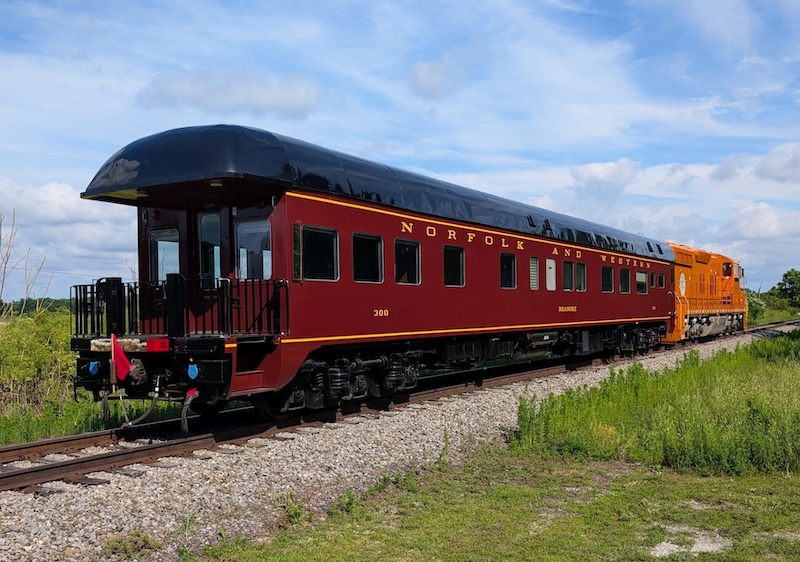
N&W 300 on its way to the Hoosier Valley Railroad. Photo Courtesy of the Norfolk & Western Business Car 300 Preservation Society.
Earlier this year, the group decided to reunite its two cars. N&W 300 was moved by Indiana Northeastern, Norfolk Southern, and Chesapeake & Indiana before arriving at the Hoosier Valley this week. The car will be used in excursion service at the museum and will make its operating debut on July 10 during the Civilians and Soldiers in History Day. Tickets to ride the car will be $35 per person and will be available this Friday on the Hoosier Valley Railroad Museum website.
For more information and to learn how to help, visit nw300.org.
—Justin Franz
The post N&W Business Train Cars Reunited appeared first on Railfan & Railroad Magazine.
Mt. Rainier Puts Polson 2-8-2 Back in Service
Washington’s Mt. Rainier Scenic Railroad has completed a Federal Railroad Administration-mandated overhaul on Polson Lumber Co. 2-8-2 70, less than a year after the locomotive was taken out of service. The engine was doing test runs on the tourist railroad over the weekend and will likely enter regular service soon.
Polson 70 was built by Baldwin Locomotive Works in 1922 and hauled logs in the Pacific Northwest for decades, first for Polson and then for Rayonier. The engine has been MRSR’s primary steam power for years but was due for an inspection and rebuild last year. The FRA requires a full rebuild every 1,472 service days or 15 years of service, whichever comes first. At the time, MRSR planned to focus on another locomotive, Porter-built Carlton & Coast Railroad 5, before returning 70 to service. But over the winter, the museum’s shop crew determined that 70 could be returned to service more quickly.
The Mt. Rainier Scenic Railroad began operations on a former stretch of Milwaukee Road track in 1980 and was purchased by American Heritage Railways — which also owns Colorado’s Durango & Silverton — in 2016. The railroad was renamed the Mt. Rainier Railroad & Logging Museum by American Heritage Railways but struggled to succeed. It was closed in 2020 at the start of the pandemic. In 2023, it reopened as the nonprofit Mt. Rainier Scenic.
—Justin Franz
The post Mt. Rainier Puts Polson 2-8-2 Back in Service appeared first on Railfan & Railroad Magazine.
Morristown & Erie Releases Semiquincentennial Unit
In a shower of sparks and shroud of smoke, New Jersey’s Morristown & Erie Railway unveiled its semiquincentennial locomotive on June 20.
Built by EMD in 1977 as Southern Railway MP15DC 2354, the locomotive has been renumbered Morristown & Erie 26. The scheme pays tribute to the Southern’s style and lines, while staying true to M&E’s classic red paint, said Matt Phalon, railroad superintendent. The paint job took about three weeks to complete. “We didn’t have to measure (for the new paint),” he said. “It still had its Southern paint underneath.”
The Morristown area holds historic significance in the American Revolution. George Washington established his 1779-80 winter headquarters in Ford Mansion, which is now part of nearby Morristown National Historical Park. To commemorate that connection, the railroad put “Washington Headquarters” under the cab, and “Crossroads of the Revolution” on the hood.
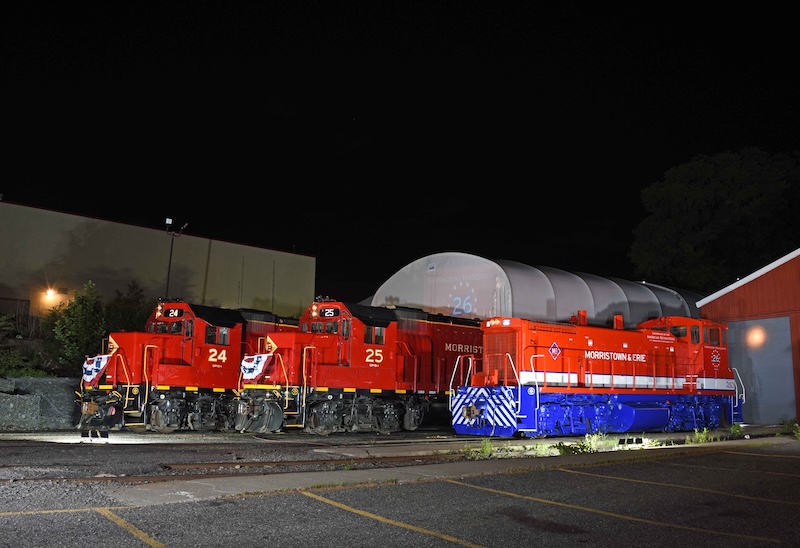
Morristown & Erie Railway’s “America 250” locomotive rolled out of the Morristown, N.J., shop building on Saturday, June 20, 2026. Photo by Michael T. Burkhart
About 36 hours before the debut, an invitation went out on social media for the public (and railfans) to view the unveiling from a nearby elevated parking lot. Despite numerous other rail-related events that day (a streetcar trip in Philadelphia, Pa., Pennsy steam at Williams Grove, Pa., and a historical society convention in the Harrisburg area), about 100 people turned out. Following the debut, the crowd was invited to take an up-close look and take night photos.
The switcher was retired by Norfolk Southern in 2016 and purchased at auction by the M&E, Phalon said. After being leased to a Staten Island, N.Y., container operation, it returned to Morristown in the fall of 2024 and received a new main generator along with a black Erie Railroad-style paint scheme.
The locomotive was expected to be briefly put on display at the Whippany Railway Museum before entering regular freight service.
The M&E dates back to 1895, when it was known as the Whippany River Railroad. While in the past it was best known as an Alco-road, today its fleet consists mostly of four-axle EMDs.
—Michael T. Burkhart
The post Morristown & Erie Releases Semiquincentennial Unit appeared first on Railfan & Railroad Magazine.
Cincinnati Scenic Saves NKP Express Car
The Cincinnati Scenic Railway, operator of the LM&M Railroad and Ohio Rail Experience, recently acquired a former Nickel Plate Road express car.
The car, former NKP 8505, was built in 1947 and used on the railroad’s passenger trains between Buffalo and Chicago. It later ended up on the Norfolk & Western and Norfolk Southern. The car eventually ended up in Kansas. The car was purchased from American Heritage Railways and moved with assistance from the Abilene & Smoky Valley Railroad in Kansas and Case Towing in Lebanon, Ohio.
The car is presently painted for the N&W and numbered 410. Cincinnati Scenic plans on restoring it to its NKP appearance and using it as a power car. The car is part of an effort by Cincinnati Scenic to restore NKP equipment important to Ohio; the group is also working to restore NKP GP9 532. Both pieces of equipment will be used on Cincinnati Scenic’s Ohio Rail Experience excursion operation around Ohio and the LM&M out of Warren County.
—Railfan & Railroad Staff
The post Cincinnati Scenic Saves NKP Express Car appeared first on Railfan & Railroad Magazine.
Pages