As Southern California prepares to welcome the world for a summer of internationally watched soccer matches, the Los Angeles – San Diego – San Luis Obispo (LOSSAN) Rail Corridor Agency, which manages the Amtrak® Pacific Surfliner® service, and Los Angeles Tourism & Convention Board announced a new partnership on March 30 “designed to help fans experience Los Angeles and the greater Southern California region with ease—on match days and beyond.”
Pacific Surfliner now offers an additional daily roundtrip between San Diego and Los Angeles. Fans across Southern California will experience this partnership firsthand as a brightly wrapped train car travels along the 351-mile coastal corridor “to build excitement, celebrate the region, and remind riders of the world’s most-watched soccer matches coming to Los Angeles this summer.”
“Southern California is built for moments like this—world-class sports, iconic destinations, and a connected coastline,” said Jason Jewell, LOSSAN Rail Corridor Agency Managing Director. “By partnering with the Los Angeles Tourism & Convention Board, we’re making it easier for soccer fans from around the globe, as well as local supporters, to experience Los Angeles without the stress of traffic or parking, while also discovering everything Southern California has to offer.”
As part of the partnership, travelers can unlock a 20% discount on Pacific Surfliner fares to and from Los Angeles between May 1, 2026 – July 15, 2026.
“Los Angeles is ready to welcome fans from near and far this summer,” said Eileen Hanson, Chief Marketing Officer of the Los Angeles Tourism & Convention Board. “Pacific Surfliner makes it easy for visitors to experience LA like a local by arriving sustainably, exploring beyond the stadium, and discovering the diverse neighborhoods, beaches, and iconic attractions that make Los Angeles such a dynamic global destination.”
More information is available here.
TriMetOn Saturday, April 18, from noon to 3 p.m., TriMet will host a public celebration of its Type 1 MAX trains before they go out of service forever.
The event will be at Holladay Park in Northeast Portland, adjacent to the agency’s Lloyd Center/NE 11th Ave MAX Station. Anyone can join in this historic moment and interact, possibly for the last time, with a piece of regional and national transit history. It’s an opportunity to say goodbye to a train that has provided hundreds of thousands of trips over the past 40 years.
The Type 1s launched modern light rail in the Portland metro area in 1986. In doing so, the vehicles set a standard for other public transportation agencies to follow. After nearly four decades of service—providing millions of trips and traveling millions of miles—the remaining Type 1s are now 10 years past their due date, with their final days numbered.
TriMet began decommissioning the vehicles—preparing them for recycling or donation—in 2024 as the agency began introducing its newest trains, the Type 6s. The Type 1s, among the oldest light rail vehicles still operating on a major transit system in the United States, had exceeded their lifecycle, and replacement parts for them had become difficult to source.
“As much as the Type 1 has served as a reliable means of transportation for countless people over the decades, it has also acted as an inspiration for what’s possible here at TriMet,” TriMet General Manager Sam Desue Jr. said. “Without top-notch mechanics, operators, supervisors, cleaners and others, these trains would not have been able to provide the decades of service they have.”
The April 18 event will celebrate the 40-year history of the Type 1 and the employees, current and retired, who helped keep these trains running amid a changing system.
MBTAGovernor Maura Healey on March 31 announced a series of summer fare promotions and discounts on the MBTA Commuter Rail “to lower costs for riders, support regular commuters and encourage more people to choose public transportation as Massachusetts prepares for a busy season of major events across the state.”
Governor Healey made the announcement at North Station alongside Lieutenant Governor Kim Driscoll and Interim Transportation Secretary and MBTA General Manager Phil Eng on Monday, where they outlined four promotions that will run on the Commuter Rail through June, July, and August, including Free Fridays, a 50% discount on monthly passes, and more. Monthly passholders will save between $321 and $639 over the summer, depending on their route.
With major events and increased travel expected across the state this summer, the Administration is focused on making sure people have a reliable, affordable alternative to driving so we can reduce congestion, support daily commuters, and keep Massachusetts moving, the MBTA noted. These steps will help residents and visitors get around during a busy summer while making public transportation a more convenient choice for everyday travel.
“As we prepare for events like the World Cup, MA250, Tall Ships, and for millions of visitors to experience all that Massachusetts has to offer, we want to thank our regular riders that rely on us 365 days a year for your patience and continuing to choose transit during this unprecedented summer. These free and discounted summer Commuter Rail services are a Thank You to our regular passengers and to encourage more people to experience the convenience of leaving their cars at home and choosing transit,” said Interim Secretary of Transportation and MBTA General Manager and CEO Phillip Eng. “We are committed to furthering MassDOT’s mission of providing safe, reliable, and resilient transportation in every corner of the state, and we hope passengers across the region take advantage of our Free Summer Fridays, summer discounts, and bringing a friend on the Commuter Rail on weekends for just $1 each way to explore the many wonderful recreational opportunities Massachusetts has to offer just a train trip away.”
The following fare promotions will be available through June, July and August 2026:
Free Summer FridaysAll Commuter Rail service will be free on Fridays in June, July, and August 2026, including Juneteenth and July 3. Regular fares will be in place for Boston Stadium Trains, the CapeFLYER, and any other special event trains to Foxboro.
50% Discount on Monthly Commuter Rail PassesCalendar month Commuter Rail passes for June, July, and August 2026 will be discounted by 50%. This discount applies to full fare and reduced fare monthly passes for Zones 1 through 10, Interzone 1 through 10, and Commuter Ferry passes. This discount will not apply to Zone 1A passes. All non-calendar month Commuter Rail products (for example, single-ride tickets, 5-Day Flex Passes, and Weekend Passes) will remain at their standard prices.
Expanded Weekend Travel for Monthly Pass HoldersMonthly Commuter Rail passes will be valid for travel to any zone on weekends. Zone 1 through 10 pass holders may travel through Zone 10, and Interzone pass holders may travel through Interzone 10. This does not apply to Zone 1A passes or ferry service. Regular fares will be in place for Boston Stadium Trains, the CapeFLYER, and any other special event trains to Foxboro.
$1 Weekend “Summer Companion” Fare for Commuter Rail Monthly Pass HoldersMonthly pass holders may bring one companion on any weekend Commuter Rail trip covered by their pass for $1 each way. This offer is limited to one companion per pass holder. Regular fares will remain in place for Boston Stadium trains, the CapeFLYER, and other special event trains to Foxboro.
To support increased ridership during the FIFA World Cup, the MBTA will temporarily adjust Commuter Rail schedules in June and July, including expanded service to accommodate up to 20,000 passengers on 14 trains per match day to Boston Stadium.
The MBTA says it recognizes that these temporary schedule changes may affect regular riders. These fare discounts are intended to offset those impacts, support regular riders, and encourage more people to choose transit during a busy summer season and beyond.
The post Transit Briefs: Amtrak Pacific Surfliner, TriMet, MBTA appeared first on Railway Age.
Total carloads for the week ending March 28, 2026, were 233,833 carloads, down 0.8% from the prior-year period, while U.S. weekly intermodal volume was 282,088 containers and trailers, up 1.6% from last year, according to the AAR.
Six of the 10 carload commodity groups posted an increase compared with the same week in 2025. They included chemicals, up 2,027 carloads, to 36,589; petroleum and petroleum products, up 1,129 carloads, to 11,239; and grain, up 819 carloads, to 24,010. Commodity groups that posted declines included coal, down 5,295 carloads, to 57,636; nonmetallic minerals, down 1,186 carloads, to 30,174; and metallic ores and metals, down 406 carloads, to 20,201.
For the first 12 weeks of 2026, U.S. railroads reported cumulative volume of 2,684,108 carloads, rising 4.2% from the same point last year; and 3,311,403 intermodal units, down 0.2% from last year. Total combined U.S. traffic for the first 12 weeks of this year was 5,995,511 carloads and intermodal units, a 1.7% increase over 2025.
North American rail volume for the week ending March 28, 2026, on nine reporting U.S., Canadian, and Mexican railroads totaled 342,214 carloads, dipping 2.1% from the same week last year, and 371,548 intermodal units, gaining 0.8% over last year. Total combined weekly rail traffic in North America came in at 713,762 carloads and intermodal units, down 0.6%. North American rail volume for the first 12 weeks of this year was 8,245,424 carloads and intermodal units, up 1.8% from 2025.
For the week ending March 28, 2026, Canadian railroads reported 94,298 carloads, falling 2.4%, and 73,994 intermodal units, dropping 4.8% compared with the same week in 2025. For the first 12 weeks of this year, they reported cumulative rail traffic volume of 1,932,183 carloads, containers, and trailers, up 0.9%.
Mexican railroads reported 14,083 carloads for the week ending March 28, 2026, an 18.5% decrease compared with the same week last year, and 15,466 intermodal units, a 16.9% gain over last year. Their cumulative volume for the first 12 weeks of this year was 317,730 carloads and intermodal containers and trailers, rising 10.2% from the same point in 2025.
Further Reading:The post AAR: U.S. Rail Traffic Flat for Week 12 appeared first on Railway Age.
CSX on March 30 reported issuing a 2025 Annual Report (above), outlining two “landmark” projects—its completion and reopening of Baltimore’s Howard Street Tunnel and the rebuilding of 60 miles of the Blue Ridge Subdivision—and citing improved safety and other efforts. This follows the Class I’s fourth-quarter and full-year 2025 financial report, released in January.
“2025 was a challenging year for CSX,” Steve Angel wrote in the report’s letter to shareholders. “Severe weather disruptions and the simultaneous execution of two large-scale infrastructure projects constrained our network early in the year, and a soft freight environment and unplanned customer closures offered little support. Revenue declined 3% on flat volume, operating margin decreased 400 basis points and adjusted operating margin contracted 360 basis points. Earnings per diluted share decreased to $1.54, with adjusted earnings per diluted share at $1.61. These results fell short of our expectations. But our employees accomplished a great deal in 2025 that positions this railroad for stronger operational and financial performance in 2026. They delivered two of the most consequential infrastructure projects in CSX’s recent history, recovered service performance through the second half of the year, and improved safety across the network.”
Among the report’s key highlights:
CSX said it made progress across “core priorities” in 2025, including:
CSX’s 2025 Annual Report also includes the railroad’s Form 10-K for the fiscal year ending Dec. 31, 2025, along with other information on safety, service, growth, sustainability, and governance.
Further Reading:“Congratulations to our North Platte West Shop on 5 years injury free,” UP reported via social media on March 31. “This milestone doesn’t happen by chance—it happens when teams support each other, share knowledge and look out for each other every day.” The team, it noted, “truly leads with care and collaboration.”
The shop is part of the Class I’s Bailey Yard, which was named for former UP President Edd H. Bailey and covers approximately 2,850 acres. Also part of the yard complex is the non-profit Golden Spike Tower and Visitor Center, an eight-story building overlooking the railroad staging area that is open to the public year-round.
In December, UP’s Chicago Service Unit celebrated working more than 365 days injury-free.
The railroad closed 2025 with what Chief Safety Officer Rod Doerr recently reported was “the best employee safety record in our history, improving 24% from 2024.” That progress, he said, “reflects years of practical, field-driven change across the railroad.”
Further Reading:The post Class I Briefs: CSX, UP appeared first on Railway Age.
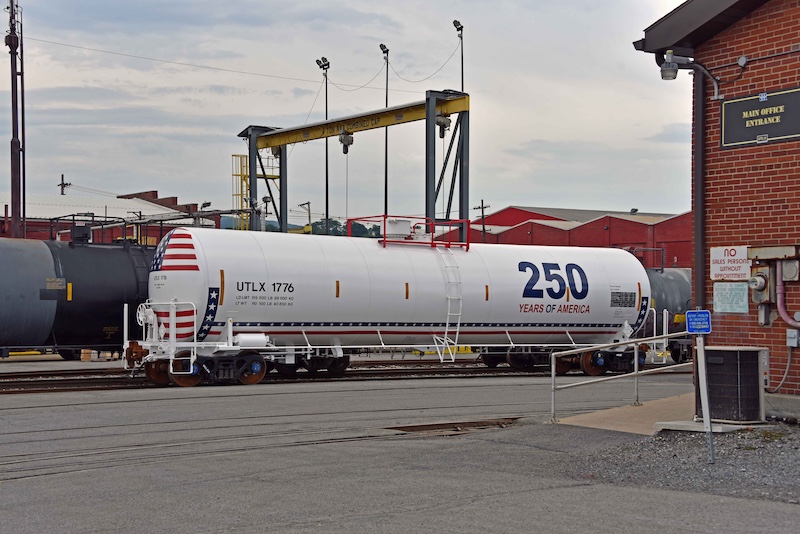
The Greenbrier Companies, Inc. and TTX Company March 31 joined the rail-industry-wide celebration of the United States’ 250th anniversary by unveiling five custom-painted, U.S. flag-themed boxcars at Greenbrier’s Cleburne, Tex., maintenance facility. The event, Greenbrier noted, “honored the nation’s history, the strength of North American manufacturing and the essential role freight rail has played in shaping the U.S. economy for nearly two centuries.” The boxcar scheme “honors America’s heritage, and the role railroads have played in supporting commerce, connecting communities and strengthening national infrastructure.” In 2027, the U.S. rail industry will mark 200 years.
The Greenbrier CompaniesThe commemorative boxcars, Greenbrier said, “symbolize the ingenuity, craftsmanship and deep partnership between TTX and Greenbrier in supporting the North American freight rail network.” Government officials, including Federal Railroad Administrator David Fink, Texas State Representative Helen Kerwin (R-58th District) and Cleburne Mayor Pro Tem Blake Jones, joined company, military, community and rail industry leaders, company veterans, employees, and media (among them Simmons-Boardman Publishing Corp. Rail Group Publisher Jonathan Chalon) to mark the occasion and “highlight the enduring importance of American railroading and the nation’s industrial capability.”
Jonathan Chalon photo“These American flag boxcars commemorate more than 250 years of U.S. history by highlighting the innovation, operational excellence and strategic partnerships that drive North American freight rail today,” said TTX CEO Tom Wells. “We are proud to partner with Greenbrier to deliver solutions that keep commerce moving efficiently and honor the enduring legacy of our industry. We also thank everyone who helped make this project a reality, including Williams Hayward Protective Coatings, Inc., for generously donating the paint.”
“This project demonstrates the strength of Greenbrier’s longstanding partnership with TTX and our shared commitment to supporting the North American economy,” said Greenbrier President and CEO Lorie Tekorius. “The North American integrated rail network is the circulatory system that keeps goods moving efficiently and reliably, and we are proud to continue this important work. Freight railcars can remain in service for up to 50 years, meaning this American‑flag boxcar will travel across America’s rail network for decades to come. It serves as a visual reminder of the vitality of the rails as America moves toward its third century, thanks to the people who keep it running every hour of every day.”
The boxcars, high-cube, 60-foot Plate F units, numbered 636706-636710 and built in Greenbrier’s Sahagun, Mexico plant, enter service this year into the North American interchange fleet, operating in TTX’s pooled service in the U.S., Canada and Mexico. As such, they appropriately sport some lettering in English and Spanish, for example, “CLOSE AND LOCK DOORS BEFORE MOVING CAR,” which in Spanish is “CIERE Y PONGA EL SEGURO EN LAS PUERTES ANTES DE MOVER EL CARO.”
Jonathan Chalon photoLake Oswego, Ore.- headquartered Greenbrier designs, builds and markets freight railcars in North America, Europe, Brazil, and the Middle East, and provides freight railcar wheel services, parts, maintenance and retrofitting services in North America. Greenbrier owns a lease fleet of approximately 17,000 railcars that originate primarily from its manufacturing operations, and offers railcar management, regulatory compliance services and leasing services to railroads and other North America railcar owners.
TTX, jointly owned by North American Class I railroads, is a railcar pooling company founded as Trailer Train in 1955 by the Pennsylvania Railroad, Norfolk & Western and Rail-Trailer Corporation. The company’s fleet consists of more than 180,000 railcars. “TTX helps railroads meet their customers’ needs by providing well‐maintained railcars in an efficient, pooled environment, investing $6 billion in additional railcars over the past 10 years alone,” the company notes. “TTX has a complete engineering and design team to care for its large and varied fleet with maintenance operations in terminals across the network. TTX also invests in and operates sophisticated industry technology solutions. These solutions improve the quality and timeliness of financial and operating information for managing its business and are shared with its owners to help them manage theirs. TTX also is a recognized innovator in the technical design and engineering of railcar components.”
The post GBRX, TTX Unveil U.S. Flag-Themed Boxcars appeared first on Railway Age.
Each year, the STB calculates the change, if any, in how efficiently railroads move freight. It determines this figure by comparing year-to-year the average cost of producing a unit of railroad output.
The Board in its decision (download below) proposes to adopt 1.015 (1.5% per year) as the measure of average (geometric mean) change in railroad productivity for the 2020-24 (five-year) period. This represents an increase of 0.1% from the average for the 2019-23 period, which came in at 1.014 (1.4% per year). The average for the 2019-23 period rose 0.2% from the average for the 2018-2022 period (1.011 or 1.1% per year), which was down 1.6% from the average for the 2017-2021 period.
52984DownloadAccording to the STB, the cost recovery procedures since 1989 have required that the quarterly rail cost adjustment factor (RCAF) be adjusted for long-run changes in railroad productivity. (For more, read: STB Sets 2Q26 Rail Cost Adjustment Factor) “This long-run measure of productivity is computed using a five-year moving geometric average,” the Board reported. “The productivity change for the year 2024 is 1.014, based on changes in input and output levels from 2023, and represents a decrease of 2.5% from the rate of productivity growth in 2023 relative to 2022 (1.040). Incorporating the 2024 value with the values for the 2020-2023 period produces a geometric average productivity growth of 1.015 for the five-year period 2020-2024, or 1.5% per year. As the new geometric mean was computed by replacing the 2019 figure of 1.007 with the larger figure of 1.014 for 2024, there was an increase of 0.1% in the geometric mean from last year’s value.”
The STB is requesting comments by April 15 “addressing any perceived data and computational errors in the Board’s calculation.” It noted that “[a]ny party proposing a different estimate of productivity growth must, at the time it files comments, furnish the Board with one set of detailed workpapers and documentation underlying its calculations. The same information must be made available to other parties upon request.”
The post STB Calculates Five-Year Change in Railroad Productivity appeared first on Railway Age.
Under the terms of a new service agreement with Texas Materials and BNSF, Central Texas and Colorado River Railway, LLC (CTXR), an OmniTRAX affiliate, will provide unit train transportation of aggregates from the San Saba quarry to the BNSF interchange in Lometa, Texas.
“CTXR has a long history of serving Texas and our belief in the region and the line have driven us to cultivate new partnerships and restore service,” said OmniTRAX President and COO Sergio Sabatini. “Infrastructure sparks economic development and we are excited to resume safe, efficient rail operations that bring new business in the region.”
Having last operated in 2019, extensive capital investments on the CTXR between the quarry and Lometa were needed to restore operational safety and support service growth, OmniTRAX noted. The initial 49-mile rail rehabilitation improvements include an expansive network of bridges and crossings, including major structures crossing the Colorado and San Saba Rivers.
“The reopening of the CTXR Railroad is tremendous news for San Saba and the surrounding region,” said San Saba Mayor Ken Jordan. “Our community depends on reliable transportation infrastructure, and seeing this project progress so well gives us real confidence in the economic opportunities ahead. We are grateful for CTXR’s commitment to completing this work and look forward to the positive impact the restored rail service will bring to local businesses and residents.”
Final track testing and car movements continue to ready the line for renewed freight service to the region, according to OmniTRAX. The CTXR infrastructure upgrades, the company says, “will enhance safety, reduce interstate truck congestion, and support future growth.”
“The CTXR line is a critical link in our supply chain, and its reopening will significantly strengthen our ability to serve key customers across the region,” said John Shogren, President, Texas Materials Central Region. “Reliable rail access provides greater shipping capacity and the ability to transport high volumes of critical materials more efficiently over longer distances.”
The post OmniTRAX Completing Infrastructure Investments to Resume Central Texas Rail Operations appeared first on Railway Age.
On Nov. 3, 2024, a Quebec North Shore and Labrador Railway (QNS&L) freight train was traveling south toward Sept-Îles, Quebec, on the Wacouna Subdivision when seven cars derailed on the main track near Saumon Station. About 250 feet of track was damaged. There were no injuries and no environmental damage, according to the TSB report (download below).
The investigation determined that “the train separated into two sections after the yoke, a part of the coupler assembly, on the second car failed. Following the separation, the two sections of the train collided, causing the east rail to roll over, leading to the subsequent derailment.”
Post-occurrence examination, according to the report, “found that the yoke had internal porosity in a high-stress area.” This porosity, the TSB says, was not detected during manufacturing, as the Association of American Railroads (AAR) does not require non‑destructive testing for couplers. The in-train forces before the failure were found to be within AAR specifications.
R24Q0089-ENGDownloadThe post TSB: Broken Railcar Coupler Led to 2024 Quebec Derailment appeared first on Railway Age.
“Get ready for an unforgettable day of connection, learning and inspiration,” says the LRW, a professional association whose mission is to improve the railroad industry by connecting and cultivating women in rail.
The symposium will kick off with experiential tours of the CSX Railroad Education and Development Institute (REDI), which has trained more than 100,000 employees, customers, and industry partners in safety, technical skills, and leadership since its launch in 2005; and of Norfolk Southern’s corporate headquarters, which opened in 2021 and was designed to support modern collaboration and innovation.
In addition to dynamic networking opportunities, symposium attendees will participate in professional development sessions to help boost their careers. The sessions include:
Secure your spot today for the LRW’s “Laying the Tracks Forward: Strengthening Your Story,” to be held June 1 at the Hotel Colee in Atlanta. Standard registration (April 1 to May 15) is $250 for LRW members and $300 for non-members. Late registration (May 16-May 31) is $300 for LRW members and $350 for non-members.
Other sponsors include:
The LRW has collaborated with Railway Age on the RA / RT&S Women in Rail Conference since 2023. Our mutual goal: supporting and acknowledging women within the industry.
The post LRW Annual Symposium Set for June 1 appeared first on Railway Age.
The Trolley Museum of New York recently took delivery of a former SEPTA Market–Frankford Line rapid transit car, an important piece of Philadelphia transit history. Car 618 arrived at the museum in Kingston, N.Y., on March 28.
Car 618 was one of 270 M-3 cars. Built by the Budd Company and entering service in 1960, these cars became known for their durability, distinctive fluted stainless-steel construction, and decades of reliable service carrying millions of passengers across West Philadelphia, Center City, and Frankford. Railfans affectionately nicknamed the cars “Almond Joys” due to their distinctive roof humps, which gave them a profile reminiscent of the popular candy bar. The only other surviving member of this class was recently restored to operation at the Pennsylvania Trolley Museum.
Often referred to locally as the “El,” the Market–Frankford Line is one of the oldest continuously operated rapid transit routes in the United States, with elevated and subway operations dating back to 1907. Budd-built cars such as 618 represented a major technological step forward at the time, emphasizing lightweight construction, corrosion resistance, and improved passenger comfort. The fleet remained a familiar symbol of the line until retirement following the introduction of replacement rolling stock in 1999.
While Car 618 arrived safely, several windows were unfortunately vandalized prior to preservation, and restoration work is already underway. The museum is actively accepting public donations to support the effort. For more information, visit tmny.org.
The post Trolley Museum of New York Acquires SEPTA Car appeared first on Railfan & Railroad Magazine.
KBS on March 31 reported launching a new stand-alone website, www.kb-signaling.com, “giving current and prospective customers, partners, and rail industry stakeholders across the globe a direct digital entry point to the company’s signaling products, project delivery capabilities, and technical resources.” KBS, which has been a member of Munich, Germany-based Knorr-Bremse Group since 2024, develops and supplies what is described as “end-to-end wayside and onboard conventional signaling, Control, Command, and Signaling (CCS) platforms and solutions.”
KBS said its “roots extend more than a century across North American rail signaling,” and the new website reflects its focus on “safety, reliability, system compatibility, and long-term performance across critical rail infrastructure.”
According to the company, the website presents its offerings “in a structure aligned with how customers evaluate signaling systems in practice”: from individual subsystems to fully integrated projects. For example, as transit agencies weigh the cost and complexity of implementing communications-based train control (CBTC), KBS noted, many are pursuing a staged conventional-signaling upgrade, and the company helps enable this approach by being CBTC vendor-agnostic. “This interoperability between CBTC hardware and digital conventional signaling enables flexible, phased deployment and smart reuse of assets,” it said.
The website:
“In rail signaling, confidence comes from understanding the technology—and how it performs, integrates, and is supported over time,” said Craig Daniels, Head of commercial for KBS. “This website complements our technical expertise. It gives customers and partners a clear, practical way to understand our capabilities, explore our products and project experience, and engage directly with our teams as they plan and deliver complex, safety-critical programs.”
Further Reading:Actelis, a provider of networking solutions for IoT and broadband applications, recently reported receiving a follow-on order from a “major North American railway operator” to expand “trackside networking infrastructure supporting critical rail safety and control systems.”
The customer, which Actelis did not name, “has been deploying Actelis’ solutions across its network over several years and continues to expand its footprint, leveraging Actelis’ centralized management software to remotely monitor, manage, and troubleshoot its distributed trackside infrastructure,” according to the supplier.
The order will “support the continued rollout of networking solutions along challenging rail corridors, where reliable connectivity is essential for the operation of advanced safety and signaling systems, including centralized traffic control and other mission-critical applications,” Actelis said.
Tuvia Barlev (Courtesy of Actelis)The company’s “hybrid fiber networking solution” was selected for its “ability to deliver fiber-grade performance over existing infrastructure while enabling rapid deployment across extended and remote track environment,” Actelis said. “By leveraging existing infrastructure and integrating fiber and wireless components, Actelis’ hybrid fiber-copper technology allows operators to extend high-bandwidth connectivity along rail lines without the need for costly and time-intensive new fiber installation, ensuring the redundancy and reliability required for safety-critical applications, while supporting both traditional and AI-driven monitoring and network operations.”
“Rail networks require highly resilient communications systems that can perform reliably across remote and environmentally demanding terrain,” Actelis Chairman and CEO Tuvia Barlev said. “This follow-on order reflects the customer’s continued confidence in our ability to deliver secure, high-performance connectivity for trackside infrastructure supporting critical safety systems.”
Further Reading:The post Supply Side: KBS, Actelis appeared first on Railway Age.
Siemens on March 30 announced the appointment of Ann Fairchild as President and CEO of Siemens USA, the company’s largest market globally. Fairchild, who has served as interim President and CEO since October 2025, will assume the permanent role effective immediately. She will guide Siemens’ strategy and engagement across the U.S., where the company employs more than 50,000 people in all 50 states and Puerto Rico and generated $24 billion in revenue in fiscal 2025.
Based on her more than 25 years at Siemens, most recently serving as General Counsel for Siemens USA, Fairchild brings a deep understanding of the company’s business objectives and strategic priorities. She has played an important role in advancing Siemens USA’s growth, “supporting complex transactions, strengthening governance across a diverse portfolio and enabling closer alignment across the company,” Siemens noted.
“Ann Fairchild brings exactly the right leadership for this moment,” said Roland Busch, President and CEO of Siemens AG. “As U.S. customers strengthen critical infrastructure, reshore manufacturing and continue to expand their AI capabilities, Ann’s strong, steady and collaborative leadership will enable Siemens to deliver greater value for our customers. I look forward to working with Ann to advance our ONE Tech Company program in the U.S., our largest market.”
Fairchild served for eight years as general counsel of Siemens USA, overseeing legal, compliance, regulatory, and intellectual property functions, helping the company navigate complex regulatory environments while seizing strategic opportunities.
“Siemens proudly serves tens of thousands of customers nationwide and supports the backbone of the American economy—growing manufacturing, building smarter infrastructure, transforming rail networks and developing a skilled workforce,” said Fairchild. “I’m honored to help guide our efforts in this moment of opportunity—as we bring AI to the real world and help customers become more competitive, resilient and efficient.”
Fairchild is a member of the Siemens Corporation Board of Directors and serves on the Board of the German American Business Council, where she brings Siemens’ perspective to transatlantic dialogues spanning policy, diplomacy and commerce. She was also recently appointed to the board of directors of Chief Executives for Corporate Purpose (CECP).
Fairchild began her career clerking for the Honorable Tommy Miller of the U.S. District Court for the Eastern District of Virginia, followed by a role as a litigation associate at McGuireWoods in McLean, Va. She joined Siemens in 1999 in the Power Generation business and has since held a series of senior leadership roles across the Legal and Compliance organization. She holds a bachelor’s degree in commerce with a concentration in finance from the University of Virginia and a juris doctor from the College of William & Mary School of Law.
HNTBCarmen C. Cham, AIA, has joined HNTB as Managing Principal for the firm’s transit architecture practice, the company recently announced.
With more than 20 years of design experience advancing major transit initiatives, Cham will lead a multidisciplinary group responsible for the design, development and delivery of transit architecture projects, working closely with clients to advance rail and public transportation infrastructure and facilities across major metropolitan regions.
The post People News: Siemens USA, HNTB appeared first on Railway Age.
CSX on March 30 launched the TRANSFLO Petersburg Terminal. Located in Petersburg, Va., the facility “reflects our commitment to delivering the benefits of rail transport with efficient transloading and maximized throughput,” according to the Class I railroad, which also operates a terminal in Richmond, Va., in addition to terminals in Tennessee, South Carolina, Quebec, Pennsylvania, Ohio, North Carolina, New York, New Jersey, Michigan, Massachusetts, Maryland, Maine, Louisiana, Kentucky, Indiana, Georgia, Florida, Delaware, Connecticut, and Alabama.
The new Petersburg terminal at 3500 Halifax Road features:
The Economic Development Corporation of Utah (EDCUtah) recently recognized BNSF with its Building Together Award, which is described as a “traveling trophy” celebrating organizations “making a meaningful impact on Utah’s economic prosperity.”
“BNSF plays a critical role in keeping Utah and the broader region connected to national and global markets,” UDCUtah reported via social media. “Their expansive rail network supports key industries across the state, from manufacturing and energy to agriculture and consumer goods, ensuring efficient and reliable movement of freight that strengthens economic growth.”
69b1dc8e10d9349a63c79075_EDCUtah Business & Economic Profile – FY 23-24 WEBDownloadAccording to EDCUtah, BNSF “continues to stand out as a strong partner in economic development,” as its “collaboration helps to deliver the logistics solutions companies depend on when choosing where to grow.”
“BNSF is honored to receive this year’s Building Together Award from EDCUtah, and proud to play a role in Utah’s economic development!” the railroad reported via social media. “We look forward to continuing to support Utah industries and growing alongside them while delivering the freight that keeps the state on the move.”
Further Reading:A team of UP engineers utilized specialized photographic equipment last year to capture millions of data points from every angle of Big Boy 4014, the world’s largest operating steam locomotive, “to create a highly accurate, high‑resolution 3D digital model,” the Class I railroad reported March 30. (Watch video above.)
The model, it said, has been used to evaluate routes on the eastern rail network, where infrastructure can vary and where Big Boy is traveling for the first time, starting May 25, in honor of America’s 250th birthday, according to UP.
The Big Boy on March 29 left Cheyenne, Wyo., to embark on the first leg of its coast-to-coast tour, making stops in California, Nevada, Utah, and Wyoming, with public display days planned in Roseville, Calif., and Ogden, Utah. It will return to Wyoming on April 24. (See map below.)
(Courtesy of UP)The second tour leg, to the East, will include display days in Omaha, Neb.; Chicago, Ill.; Buffalo, N.Y.; and Scranton, Pa., before Big Boy’s arrival in Philadelphia for Independence Day. Additional display days are anticipated in Altoona, Pa., and St. Louis and Kansas City, Mo., before the tour concludes July 29.
“This is a great example of how we utilize modern tech tools to enhance safety around a 1940s-era steam locomotive,” said Timothy Boland, Senior Manager-Engineering Infrastructure at UP. “The level of detail we’re getting allows us to validate measurements, understand how the locomotive behaves on curves, and make informed decisions before the engine ever touches the track.”
“It’s another great step toward efficient planning that provides valuable data faster and helps us share the Big Boy with the public, safely and seamlessly,” said Ed Dickens Jr., Senior Manager-Heritage Operations at UP.
ALCO manufactured 25 Big Boys for UP, 20 in 1941 and five in 1944, to haul heavy freight during World War II. They saw service until their fires were dropped for the last time in 1961. Eight survived. UP re-acquired No. 4014 in 2013 from the RailGiants Museum in Pomona, Calif., and meticulously restored her to operating condition. No. 4014 returned to service in 2019 and is the only functioning Big Boy. In 1941, Railway Age reported on its debut with an extensive technical article (download below).
RailwayAge1941UPBigBoyDownload Further Reading:The post Class I Briefs: CSX, BNSF, UP appeared first on Railway Age.
“Driven by STA’s goal to modernize regional mobility while improving reliability and lifecycle efficiency, the project included implementation of European Railway Traffic Management System (ERTMS) Level 2, the European standard for train control and supervision that allows for the continuous, reliable data exchange of movement and speed information—effectively replacing traditional physical signaling,” Progress Rail said. “The deployment positions the Merano-Malles line as the first regional railway in Italy to adopt ERTMS Level 2.”
According to Progress Rail, the scope of work includes several integrated systems, including:
For STA, adopting ERTMS Level 2 will help improve safety and reliability, increase line capacity, and reduce operating and maintenance costs, reported Progress Rail, which noted that these efficiencies “contribute to lower energy consumption and reduced environmental impact, reinforcing the region’s broader sustainability goals.” The Merano-Malles project, the supplier said, also reflects a “broader national and European commitment to interoperable rail systems,” as more than 870 miles (1,400 kilometers) of the Italian railway are already equipped with ERTMS, with that figure expected to exceed 1,740 miles (2,800 kilometers) this year.
“This project is built around STA’s operational and service goals, with our team delivering a solution designed to meet those needs today and well into the future,” said Sam Doerr, Executive Vice President of Infrastructure at Progress Rail. “By combining proven ERTMS technology with our deep signaling expertise, we are helping STA enhance safety, capacity, and long-term value through reliable performance, lower lifecycle costs, and sustainable growth.”
“The ERTMS Level 2 system is the best solution for ensuring an efficient and modern regional rail service,” said Michael Prader, Head of Rolling Stock and Schedules at STA. “It is also an essential component of the Val Venosta railway electrification project, contributing significantly to improving the safety and reliability of the entire infrastructure.”
Further Reading:Join Railway Age on Oct. 21-22, 2026, for the Next-Gen Rail Systems Conference (formerly Next-Gen Train Control), whose program will encompass the entire system, examining how signaling and train control technologies are modified and improved by telematics, artificial intelligence, deep data analysis, cybersecurity measures and more. Presented by leading experts, Next-Gen Rail Systems will feature in-depth technical sessions and comprehensive project updates on evolutionary and revolutionary developments in advanced and emerging technologies.
The post For Italy’s Merano-Malles Line, ERTMS Level 2 appeared first on Railway Age.
The 2026 Economic Impact Report for the rail supply industry is now available (download below). Produced in partnership with Oxford Economics, it updates the 2023 edition and is supported by the Railway Supply Institute (RSI), primary sponsor, as well as the Railway Tie Association (RTA), Railway Engineering-Maintenance Suppliers Association (REMSA), and Amtrak. The report serves not only as a “strategic tool to inform policy discussions and highlight the value of a strong, resilient rail supply network,” but also as a snapshot of the industry from 2024—the most recent full-year of data available as of publication—measured across the activity that takes place within supplier firms, the activity supported through their domestic supply chains, and the activity supported by the wages they pay, according to the partners.
Rail-Supply-Industry_Economic_Impact_2026Download“This report underscores the industry’s substantial role in the national economy,” RSI, RTA, REMSA and Amtrak said in a March 30 announcement. “The rail supply industry contributes $127 billion annually to the U.S. gross domestic product and directly employs an estimated 338,000 workers. When accounting for indirect and induced effects throughout the broader economy, total employment supported by the industry rises to approximately 906,000 jobs.”
RSI_2024impact_USDownloadThe 2026 edition of the report includes a new, expanded analysis of the industry across key market segments, which the organizations say, offers “a clearer picture of the distinct economic contributions of both freight rail and passenger rail suppliers.” It also highlights “how increased federal investment in rail programs has driven growing demand for rail suppliers and strengthened domestic manufacturing and service capacity.”
The report also quantifies Amtrak’s economic footprint. The analysis finds that Amtrak’s “procurement and capital investment activity supported approximately 45,800 jobs and generated $6.5 billion in U.S. GDP in 2024, along with $3.8 billion in labor income and $1.4 billion in tax revenue across federal, state, and local levels.” These impacts, the partners said, “driven by a nationwide network of manufacturers, engineering firms, and construction and service providers, underscore how Amtrak’s investments sustain domestic supply chains, support high-quality jobs, and drive economic activity in communities across the country.”
Detailed state impact sheets for all 50 states and D.C. are also included to provide localized insights into the industry’s far-reaching economic contributions, highlighting jobs supported, economic output, and the vital role rail suppliers play in communities nationwide, including those not directly served by rail.
RSI and its partners will actively promote the report throughout the year “to reinforce the rail supply industry’s significant economic impact and national footprint,” they said, through targeted outreach to policymakers, industry stakeholders, and the media.
“The RSI is excited to once again work with our industry and Oxford Economics to publish the latest findings of the economic impact of the rail supply industry,” said Ashley Shelton, Acting President of RSI. “Across the country, companies at every level of the rail supply chain support hundreds of thousands of jobs and drive critical manufacturing activity in communities nationwide. From specialized component manufacturers producing bearings, couplers, braking systems and advanced electronics, to original equipment manufacturers building railcars and locomotives, our industry forms the backbone of America’s freight and passenger rail network. Behind the data in this report are the stories of a dedicated workforce powering and sustaining America’s rail network every day. RSI is proud to serve as the industry’s advocate and unified voice in Washington and remains committed to advancing policies that support and strengthen the industry in the years ahead.”
“The rail supplier industry is the quiet yet powerful backbone of the U.S. economy,” REMSA President Urszula Soucie said. “This report highlights just how far-reaching and vital our industry is and quantifies the positive impact of rail across our country.”
“The RTA is proud to support this study, which highlights the significant impact of the rail supply industry and the essential role freight rail plays in a thriving U.S. economy,” added Nate Irby, Executive Director of RTA. “For RTA, that includes treated wood ties, one of the fundamental track components that helps keep the nation’s rail network safe, efficient, reliable, and sustainable.”
“These numbers reaffirm what we see every day: rail investment strengthens domestic supply chains, supports local economies and drives America’s transportation future,” Amtrak President Roger Harris commented. “As we modernize our fleet, upgrade stations and advance major infrastructure projects nationwide, Amtrak remains committed to creating jobs, expanding opportunity and delivering the world-class passenger rail network Americans deserve.”
“Oxford is proud to partner once again with the rail supply industry on a new report measuring the sector’s substantial economic impact,” said Hamilton Galloway, Head of Americas Consultancy for Oxford Economics. “The results continue to underscore the industry as a powerful economic engine in every state. Excitingly, this year’s expanded analysis also delivers new, segment-level insights—including breakdowns of freight vs. passenger rail suppliers and a dedicated look at Amtrak’s procurement and capital investments. These new research enhancements offer a clearer, more comprehensive view of how the industry drives jobs, investment and growth across the United States.”
“RSI’s report highlights the strength of a rail ecosystem that delivers real, measurable value across the American economy,” added Ian Jefferies, President and CEO of the Association of American Railroads. “Freight rail alone generates more than $233 billion in economic output and supports hundreds of thousands of jobs nationwide, with every dollar invested producing $2.50 in broader economic activity. Together, railroads and their suppliers are not only sustaining high-quality domestic jobs, but powering the industries and supply chains that keep America competitive.”
“The rail supply industry is crucial to the success of short line railroads and the thousands of customers we serve,” said Chuck Baker, President of the American Short Line and Regional Railroad Association. “Members of RSI, REMSA and RTA are critical in enabling short lines to solve operational issues, complete infrastructure upgrades efficiently and serve customers safely and effectively. This study further demonstrates the tremendous economic impact of the rail supply industry on the nation’s economy.”
“The RSI’s new Oxford Economics report comes at a pivotal moment as Congress begins writing the next surface transportation bill,” noted Paul Skoutelas, President and CEO of the American Public Transportation Association. “It makes clear that America’s passenger rail supply chain—from manufacturers to construction firms—is a powerful economic engine supporting more than 333,000 jobs and nearly $46 billion in GDP across all 50 states. It’s American workers building the infrastructure that moves people and powers our economy. APTA commends RSI for quantifying this impact and urges lawmakers to recognize that investing in passenger rail means investing in a domestic workforce that delivers returns in every congressional district.”
The post New Report Showcases Rail Supply Industry’s Economic Impact, National Footprint appeared first on Railway Age.
The Prairie Economic Gateway is part of a larger initiative to strengthen infrastructure across Calgary. SDC recently reached the milestone of conceptual scheme and land use approval and awarded EXP the contract through a qualifications-based selection.
The Shepard Logistics Centre development is a jointly planned collaboration between SDC, the City of Calgary and Rocky View County (RVC), and will result in a nearly 1,300-acre rail-serviced industrial hub. The project, EXP says, will support the manufacture, storage and distribution of commercial products. With more than 20 million square feet available for future industrial development, this inland port is strategically located near the TransCanada Highway, CANAMEX Trade Corridor and Canadian Pacific Kansas City (CPKC) main line “to maximize efficiency of transportation between the U.S., Mexico, Canada and global markets.”
EXP will provide civil engineering design both onsite and offsite, landscape architecture services, oil and gas main/well decommissioning and infrastructure asset coordination. The company will also support SDC in their communication with stakeholders and surrounding jurisdictions, to advance Phase 1’s 480 acres. Through detailed engineering design and professional services, EXP will assist SDC with scheduling and cost predictability.
Servicing is expected to proceed through 2029.
The post EXP Selected to Deliver Engineering Services for Shepard Logistics Centre appeared first on Railway Age.
U.S. Sugar has decided to donate an Atlantic Coast Line 4-6-2 to the Tennessee Valley Railroad Museum. U.S. Sugar acquired ACL 1504 in 2021 with plans to expand its popular Sugar Express excursion operation. After purchasing the USRA light Pacific from the City of Jacksonville, Fla., it was moved to Chattanooga for restoration by FMW Solutions, which had previously completed the restoration of ex-Florida East Coast 4-6-2 148 for U.S. Sugar.
In March, Sugar Express announced that rising material costs and the realization that locomotive 148 was sufficient for the operation led it to decide not to proceed with restoring 1504.
“U.S. Sugar continues to provide a world-class excursion train in America’s Sweetest Town, with Steam Locomotive No. 148 serving as the Sugar Express’ primary motive power and ambassador to us here at U.S. Sugar,” said M. Scott Ogle, Railroad Superintendent of the Sugar Express. “After considering the Sugar Express’ future, we have decided that Steam Locomotive No. 148 is sufficient for meeting the overwhelming demand of guests that ride on our one-of-a-kind, scenic excursion line that traverses hundreds of miles through the core of Florida’s pristine farming communities.”
TVRM announced it will perform a thorough evaluation of the locomotive before making any decisions about its future. ACL 1504, built by the American Locomotive Company in 1919, is the only remaining USRA light Pacific-type steam locomotive.
The post U.S. Sugar Donates ACL 4-6-2 to Tennessee Valley appeared first on Railfan & Railroad Magazine.
The LACMTA Board on March 26 “unanimously approved a plan that will reshape how residents get around the city,” according to KTLA 5 in Los Angeles, Calif.
The Board selected the San Vicente–Fairfax alignment as the Locally Preferred Alternative (LPA) for the K Line Northern Extension, a 10-mile, 10-station underground extension of the K Line that will run from the E Line north to Hollywood (see map, top). The new rail service will connect with LACMTA’s B, C, D, and E lines, serving six of LA’s busiest bus corridors and improving access to jobs, healthcare, and entertainment (download Fact Sheet below).
053a07067d1eae076d1423315ab37f78Download“Supporters said the extension will provide direct rail connections to major destinations, including LAX, the Kia Forum and SoFi Stadium,” the media outlet reported. “However, there was some pushback from homeowners concerned about tunneling beneath their neighborhoods.”
LACMTA “has tunneled in a variety of projects throughout Los Angeles County, and many homeowners participated in a tour throughout Los Angeles County of all of the work that Metro has done,” L.A. County Supervisor Lindsey Horvath said, according to KTLA 5. “They continue to do safety studies and additional technical analysis to address the concerns that community members have raised. And, as I said, they will continue to do so in order to address the concerns that the community members have.”
According to the media outlet, construction is slated to begin in 2041, with service starting in the late 2040s.
NYMTA (Courtesy of MTA)The New York MTA on March 25 launched an update of its mobile app exclusively for New York City subway and bus riders. With a single tap, the agency said, users can now find real-time subway and bus arrivals close to them and view the real-time position of a train or bus and its estimated time of arrival at all its future destinations, allowing riders to fully plan their trips from start to finish. The new MTA App also features 24/7 live in-app customer support to answer rider questions, as well as direct customers to other MTA services.
Customers can download or update the existing MTA App through the Apple App Store (iOS) or Google Play Store (Android). The app is available in English and Spanish.
According to MTA, the app was developed by an in-house team at a “minimal cost.” The app can be updated and improved regularly, without having to rely on third parties, it added. New features are expected later this year, including OMNY account management ride history.
MTA Chair and CEO Janno Lieber said, “The new app for subway and bus customers is making a play to be another five-star download, just like TrainTime before it. This is what happens when you invest in and empower in-house talent—best-in-class innovation without the Big Tech price tag.”
The new MTA App is said to retain “popular features that frequent users currently rely on, including favorited lines, routes and stops, per-station arrival times for specific trains and buses, improved user location accuracy, and an in-app trip planner.” It will also continue to allow users to book and manage Access-A-Ride trips. The app will not store any user data, including location, according to MTA. It added that MTA Metro-North Railroad and Long Island Rail Road customers will continue to benefit from the TrainTime App where they can buy and use tickets, plan their trips, and track their trains.
Following is a detailed breakdown of the new features in the MTA App:
BART on March 25 reported carrying more than a million riders during Super Bowl LX week (Feb. 2-8), the highest ridership week for the transit agency since the pandemic. Thursday, Feb. 5, was also the highest ridership day since the pandemic with 225,832 trips, per BART’s February Ridership Snapshot.
“Preliminary ridership numbers for March are strong,” BART reported. “Over February and into March, Saturday ridership reached 85% of pre-pandemic levels, and March to date is 14% higher compared to the same period a year ago. Tuesday, March 24, is now the third-highest post-pandemic ridership day with more than 221,000 trips.”
According to BART, the February ridership boost was driven largely by fans and visitors traveling to destinations across San Francisco for Super Bowl-related events and celebrations. The strong performance, the agency noted, highlights its “ability to move large crowds quickly and efficiently, connecting the region during moments of peak demand.”
February ridership highlights:
BART reported that Saturdays “saw particularly impressive growth, reflecting increased demand for events, entertainment, and weekend travel across the region.”
In February, more than 685,000 trips were taken using Tap and Ride, up 7% compared with the previous month, which BART said reflected “continued adoption of contactless payment options that speed up station entry and improve the rider experience.”
BART ridership was also up in January.
Even with continued growth, fare revenue has not returned to pre-pandemic levels and is not enough on its own to fully fund operations, according to BART. “Like transit agencies nationwide, BART faces a structural budget deficit as remote and hybrid work patterns reduce traditional commute trips,” it noted. Read more about BART’s funding deficit here.
Find comprehensive BART ridership reports here and daily ridership numbers here.
Further Reading:RTD’s preliminary, unaudited 2025 financial results “indicate a 17% year-over-year revenue growth, totaling $1.3 billion revenue,” the agency reported March 26. “RTD’s financial position is strengthened by investment income and continued grant performance contributing to financial progress and disciplined management across the organization.”
Customer boardings “remain stable though reduced from 2019 levels due to enduring fully remote and hybrid work schedules which began in 2020 that impact total boardings and fare revenue,” according to RTD, which provides bus, commuter and light rail, shuttles, ADA paratransit, demand responsive, special event, vanpool, and many other services. However, RTD said its sales and use tax revenue mitigates reliance on fares solely for overall revenue. While RTD said it is “operating at a deficit during a multi-year adjustment cycle,” the agency is “focused on long-term sustainability as a provider of critical transit resources across the service area.”
Chief Financial Officer Kelly Mackey said, “Under the leadership of General Manager and CEO Debra A. Johnson, in partnership with the Board of Directors, staff is addressing the deficit head-on and preparing for the 2027 budget cycle; transparency will remain central to that work.”
RTD’s sales and use tax revenue grew 1.3% to $869 million though $34 million below budget (-4%) due to projected construction starts and permitting that did not materialize for use tax, according to the agency. RTD fare revenue of $61 million decreased 4% year-over-year and was $4 million favorable to budget (7%), it said.
The agency reported a preliminary net position decrease of $227 million, which was a 20% year-over-year improvement and $163 million (42%) better than budget. RTD boardings declined by 0.3% in 2025 compared with the prior year but increased by 4.3% in the second half of 2025 compared with the same timeframe in 2024 “due in part to an update in the A Line ridership counting method,” RTD said.
“Notably, 2025 working capital declined as pandemic-era federal funding was utilized—not only for RTD, but transit agencies nationwide—while operating costs continued to increase,” RTD reported. “Even so, liquidity remains well above pre‑pandemic levels, supporting stability and debt‑service capacity.”
RTD also reported that S&P Global Ratings on March 13 affirmed its “financial strength,” with the agency maintaining its AA+ long-term rating and underlying rating (SPUR) on certificates of participation (COPs) outstanding. “S&P affirmed RTD’s stable outlook, recognizing the agency’s healthy liquidity and manageable debt profile, while highlighting the importance of continued progress in addressing the structural deficit as the agency prepares for the 2027 budget cycle,” RTD said.
On Jan. 15, Fitch Ratings reported that RTD maintained its AA+ rating on RTD’s FasTracks revenue bonds and AA on COPs with stable outlooks across all categories, according to RTD. Similarly, it said, on Dec. 17, 2025, Moody’s affirmed that RTD maintained its ratings of Aa2 on FasTracks revenue bonds and A1 on COPs with a stable outlook.
“The credit rating agencies recognize RTD’s proactive and conservative financial management and policies and RTD’s support from voter-approved sales and use taxes that enable the agency to provide transit services for 3.1 million customers across its 2,345 square-mile service area,” RTD said. “The ratings reflect confidence in RTD’s proactive financial management and recognize the need for its essential role as a transit provider across the Denver metro area.”
Further Reading:SEPTA is launching a pilot program to deploy digital real-time arrival displays at selected trolley and bus stops, according to the transit agency. The first 10 devices will be installed later this spring.
“The screens, which are solar-powered and use e-paper technology, are unique because they are small enough to be mounted on a bus stop sign pole,” SEPTA said. “Knowing when the next vehicle will arrive was a top priority for many of the 20,000 riders who participated in the comprehensive community engagement efforts for SEPTA’s New Bus Network initiative.” Each device will be equipped with a text-to-speech button, enabling blind and low-vision riders to access the same real-time service information.
The timing of the pilot aligns with the anticipated surge in visitors expected this summer when Philadelphia hosts FIFA World Cup matches, the MLB All-Star Game, and America’s 250th birthday celebration, SEPTA reported.
Pilot locations will be selected based on two key criteria: overall customer impact and geographic equity, ensuring that the benefits of improved real-time information reach riders across all parts of SEPTA’s service area, according to the agency. Bus stops, as well as T, G, D and M Metro stations, will be considered for device locations.
“We are committed to leveraging state-of-the-art, secure technology to modernize the rider experience,” SEPTA Assistant General Manager of Information Technology Elisa Cunningham said. “We will evaluate the results of the pilot to determine future phases of deployment across the network.”
“Every improvement we make to our network starts with listening to our riders,” added SEPTA Chief Officer of Customer Experience and Communications Administration Lex Powers. “This program is one more way that SEPTA is investing in the people who depend on us—today and into the future.”
SEPTA is encouraging riders to share feedback about where they would like to see these devices installed.
Alstom (Courtesy of Alstom)Alstom on March 24 reported being selected by George Bush Intercontinental Airport (IAH) in Houston, Texas, to replace its existing Skyway automated people mover (APM) system and provide operations and maintenance services for 15 years. The contract includes a new Operations Control Center, upgraded Automatic Train Control (Urbalis) and communications systems, 16 new Innovia APM R vehicles, modernized station doors across all terminals, and continued operations and maintenance of the system. The total contract value is approximately $437 million, Alstom said.
Alstom has been operating and maintaining the Skyway APM at Houston’s largest airport for two decades, using the original Innovia APM 100 vehicles built by Bombardier Transportation, which Alstom acquired in 2021. Alstom said it has a dedicated 48‑person operations and maintenance team onsite.
“IAH is undergoing multi‑billion‑dollar expansion to accommodate record‑breaking passenger growth, which topped 48 million passengers last year,” Alstom reported. “The renewed Skyway system will reduce service disruptions, improve passenger flow between terminals, and enhance the overall travel experience. Upgraded digital communications and monitoring systems will increase operational reliability, supporting smoother journeys during peak airport demand.”
Alstom noted that interim busing will be provided when the Skyway is out of service to minimize customer impact.
“Modernizing Houston’s Skyway system is essential to meeting the needs of one of the fastest‑growing airports in the United States,” said Michael Keroullé, President of Alstom Americas. “This next‑generation APM will deliver more reliable, seamless travel for millions of passengers every year. We are proud to continue our long partnership with IAH and to help shape the future of airport mobility together.”
Separately, in March four new Alstom APM vehicles entered service at Tampa International Airport in Florida, and last May Hartsfield-Jackson Atlanta International Airport in Georgia took delivery of the first of 29 APM vehicles from Alstom.
Further Reading:The post Transit Briefs: LACMTA, NYMTA, BART, Denver RTD, SEPTA, Alstom appeared first on Railway Age.
The agreement adds R. J. Corman, which operates 19 short line railroads in 11 states and serves all major North American railroads, to a growing roster of commercial partners, noted Intramotev, which currently has active TugVolt deployments under way with Carmeuse Americas and Watco. Last month, the company announced that Ray Betler, former CEO of Wabtec, has joined its Board of Directors.
“We strive to be the best service provider to our customers by continuously improving rail operations to be as safe and efficient as possible. Deploying Intramotev’s TugVolt railcars is a direct investment in that commitment,” said Justin Broyles, President and CEO of R. J. Corman Railroad Group, which employs approximately 1,400 people in 24 states. “We’re looking forward to putting their technology to work.”
“R. J. Corman is one of the most respected operators in the rail industry, and we’re honored to work alongside them,” said Tim Luchini, CEO of Intramotev. “When it comes to proving that autonomous rail is ready for commercial deployment, there’s no better validation than a partner who has spent over 50 years moving American industry.”
The post R.J. Corman to Utilize Intramotev’s TugVolt Railcars in Switching Operations appeared first on Railway Age.
Gateway Terminals Savannah has announced the appointment of Bryan Blalock as President, effective April 13, 2026. He will succeed Kevin Price, who will transition to the GPA leadership team as the newly announced President on July 1, 2026.
“We would like to welcome Bryan Blalock to Savannah and the important role he will play supporting the ocean carriers who call Savannah. Collectively between the Georgia Ports and Gateway, our aim is to provide our mutual customers, both the Ocean Carriers and Truckers, a best-in-class experience,” said GPA President and CEO Griff Lynch.
Blalock joins from CMC where he was the COO, covering 60+ operations with 1900 employees. He brings a distinguished 35+ year career of optimizing business processes, strategic planning and innovative solutions in the port terminal industry.
“Bryan’s leadership, credentials, safety mindset and way of working with people will enable Gateway Terminals Savannah to continue on a high-performance trajectory and get closer to our customers,” said Price. “We are excited to have him join our team. He has worked in all facets of our industry, brings excellent working relationships in our region and will be immediately effective in his new role, allowing a seamless management transition.”
“I’m honored to join Gateway Terminals Savannah—a leader in the stevedore industry with its best practices and high growth. The Port of Savannah is one of the fastest growing ports in the country and I’m looking forward to helping our customers win more business by delivering best-in-class operations,” said Blalock.
CSXJudy Covington‑Poole, CSX Technical Director, was named Woman of the Year by the National Association of Railway Business Women Jacksonville Chapter, the Class I recently announced in an X post.
“Covington-Poole leads teams that help keep technology reliable so railroaders across our network stay connected and supported, Congrats, Judy—thank you for leading with service and collaboration,” CSX wrote.
Judy Covington‑Poole, CSX Technical Director, was named Woman of the Year by the National Association of Railway Business Women Jacksonville Chapter. She leads teams that help keep CSX technology reliable so #railroaders across our network stay connected and supported. Congrats,… pic.twitter.com/zc9ETHdVSJ
— CSX (@CSX) March 27, 2026 CPKCCPKC recently congratulated via LinkedIn John Furlong, Terry Savage, and Mohamed El Bitar for winning a 2026 CEO Award for Excellence for their “transformative track technology.”
“Setting a new standard for how we monitor and manage track infrastructure, their work resulted in fewer slow orders, improved asset life and more reliable service for our customers.
“With safety as our top priority, their shift from reactive fixes to predictive maintenance plays a key role in making our railroad safer, more efficient and better positioned for long-term performance,” CPKC wrote.
Northern Plains RailroadJesse Chalich, President of Northern Plains Railroad, passed away suddenly on March 11, 2026, the American Short Line and Regional Railroad Association (ASLRRA) recently announces.
Jesse Chalich“Noted in the obituary, Chalich started his career as a conductor/engineer in 1997 on the Northern Plains Railroad in central North Dakota. As a 4th generation railroader, the love for the industry and its culture ran deep in him.
“Chalich quickly moved into customer service, where his natural ability to connect with people quickly stood out. Known for his genuine care for others and the trust he built with those around him, Chalich later transitioned into marketing and executive leadership roles, helping guide the company as it expanded from 40 to more than 200 employees. Over time, he rose through the organization, ultimately serving as President and Chief Operating Officer of the Northern Plains Rail companies—a role he led humbly with pride, integrity, and dedication until his final day. Under Chalich’s leadership, the company maintained exceptional employee morale and a culture that truly supported employees in putting safety and family first.”
The post People News: GPA, CSX, CPKC, Northern Plains Railroad appeared first on Railway Age.
The CIP is a rolling, five-year financial plan that funds all MBTA capital projects, “seeking to deliver meaningful results for riders today while building a best-in-class transit system for the future,” according to the agency. Capital projects are investments or activities related to acquiring, renewing, constructing, improving, or maintaining a capital asset, including project planning and design. To support these goals, the capital projects in the proposed FY27-31 CIP focus on:
This proposed FY27-31 MBTA CIP (download below) includes more than 680 unique capital projects for a programmed spend of $10 billion over the next five fiscal years to “modernize, improve, and increase the safety and reliability of the MBTA.” These investments, the agency says, “aim to maintain a state of good repair, modernize MBTA assets, improve service, and meet strategic priorities and performance goals.” It is informed by the Capital Needs Assessment and Inventory, the MBTA Strategic Plan, and long-term plans such as Focus40, the Rail Modernization Plan, and Focus 2050, the Program for Mass Transportation (PMT) currently in development and also open to public comment now. Updated every five years, the PMT will bridge the MBTA Strategic Plan and the fiscally constrained CIP, “identifying investment priorities and potential capital improvements over 25 years through 2050.”
“Under the leadership of the Healey-Driscoll Administration and with the support of our Legislative and municipal partners, the MBTA continues to set a national example for how to accelerate transportation infrastructure projects that drive economic vitality supporting jobs, businesses, and communities,” said Interim Secretary of Transportation and MBTA General Manager and CEO Phillip Eng. “We are strategically planning to deliver capital projects that deliver meaningful benefits, improve service, and ensure safety to meet and exceed the needs of today and future generations. I invite all riders and community members to weigh in on the proposed Capital Investment Plan – your input is essential as we continue to build the MBTA in which we can all take pride.”
2026-03-26-fy27-31-proposed-cipDownloadThe post MBTA Invites Public Comment on Proposed FY27-31CIP appeared first on Railway Age.