Railnews from Railfan & Railroad Magazine


EBT to Rebuild Station, Track at Three Springs
The EBT Foundation and the Friends of the East Broad Top announced Sept. 23 that they had received a $1 million grant from Pennsylvania’s Redevelopment and Capital Assistance Program that will fund the construction of a new station in Three Springs, Pa., as well as track and bridge repairs to connect the historic narrow gauge railroad with nearby Saltillo.
Since 2020, the EBT Foundation has been rebuilding the 3-foot-gauge railroad with the goal of eventually reaching Saltillo. Trains have not run through Three Springs to Saltillo since 1956, when the original railroad closed. From 1960 until 2011, the 3.3-mile section between Orbisonia/Rockhill Furnace and Colgate Grove was operated as a tourist railroad. The railroad and the historic shop complex at Orbisonia then sat unused for nine years before the foundation purchased it. Besides reopening the line to Colgate Grove, the nonprofit set the ambitious goal of rebuilding about eight miles of track south to Saltillo. Since then, the railroad has been rebuilt to Pogue, and track work is underway just south of there and north out of Saltillo. EBT officials said the grant will help connect that southern section with Three Springs.
The station at Three Springs was demolished in 1954, and the new building will be a close recreation of the original structure based on drawings from the EBT archives. Externally, construction will mimic the appearance of the station in the 1950s, while the interior will incorporate small changes to improve functionality and accessibility while maintaining its historic appearance. The railroad rebuilt the station at Saltillo earlier this year.
“The EBT Foundation is proud to partner with the Friends of the East Broad Top on the next phase of construction to reconnect Three Springs with Saltillo,” said EBT Foundation General Manager Brad Esposito. “Much work has been done to get to this point, and I want to thank both borough councils and the many local organizations and residents who have shown interest and have participated in planning to get to this point. Additionally, I want to thank Sen. Judy Ward and Rep. Rich Irvin, as well as the Huntingdon County commissioners, for their support. Three Springs and Saltillo will play a large role in the rebirth of the East Broad Top Railroad and we are excited to help promote economic growth in these communities.”
—Justin Franz
The post EBT to Rebuild Station, Track at Three Springs appeared first on Railfan & Railroad Magazine.
Flood Recovery Efforts Underway at Whitewater Valley Railroad
Recovery after a catastrophic flood is well underway at Indiana’s Whitewater Valley Railroad, though officials say significant work remains after nearly every part of the railroad was impacted.
The West Fork of the Whitewater River crested at 21.78 feet in the early morning hours of August 13, 2026. The railroad was heavily damaged by the flood as a result. More than one month later, coaches and cabooses have been cleaned and sanitized, while the brake valves from the cars had to be sent off-site for inspection and repair. Upon reinstallation, the cars will be ready for service again.
Locomotives are proving more challenging because their electrical components were submerged in floodwaters. The railroad expects the locomotive repairs to take several months.
The primary crew office was a total loss and will need to be rebuilt.
The biggest obstacle for the railroad has been repairing its track, with nearly 16 out of 19 miles damaged by the flood. A track crew has repaired two miles so far and continues working, though the railroad anticipates major washouts occurring where the Whitewater River has changed course and now flows under the tracks. Full restoration of the line isn’t expected until sometime in 2027 at the earliest, but it could take much longer.
While much needs to be done to get the railroad running again, they have been grateful for the support from communities and preservation groups.
“The response from our members, other railroad museums and organizations, as well as the communities surrounding us has been overwhelming,” the railroad said in a statement. “We have received very generous donations of money, as well as time and labor. Being an all-volunteer organization, it is difficult to value one over the other since we are dependent on both.”
The railroad is also nearing its $40,000 matching campaign goal, which will go toward rebuilding. For more information, visit whitewatervalleyrr.org.
The Whitewater Valley Railroad is a nonprofit established in the early 1970s and has operated excursion trains with vintage diesels since 1974.
—Nick Stewart
The post Flood Recovery Efforts Underway at Whitewater Valley Railroad appeared first on Railfan & Railroad Magazine.
Adirondack Railroad Acquires Metro-North P32 ‘Genesis’ Locomotive
The Adirondack Railroad has purchased a former Metro-North General Electric P32AC-DM for excursion service out of Utica, N.Y., making it the first Genesis locomotive to enter tourist railroad service.
Locomotive 221, built in July 2001, joins the fleet after 25 years of service with Metro-North. Adirondack Railroad says it remains committed to its existing fleet of Alco and MLW locomotives, while the acquisition of 221 preserves a piece of passenger railroad history and adds an HEP-equipped locomotive to the roster.
“We are thankful for the opportunity to preserve a P32 locomotive and look forward to adding a HEP-equipped passenger diesel to our fleet of locomotives,” said Adirondack Railway Preservation Society President Luke Irvine. “We are still committed to our Alcos and have no intention of retiring any of those. This engine will also allow us the opportunity to expand operations by running a push-pull consist with our leased fleet of MBB-built coaches. We are grateful to Metro-North for this opportunity.”
The Adirondack Railroad is operated by the nonprofit Adirondack Railway Preservation Society, which began excursion operations in 1992 on the former New York Central Adirondack Division. What started as a four-mile operation out of Thendara has grown into a major tourist railroad linking Utica with the Adirondacks. Today, its High Peaks Limited operates between Utica, Thendara, and Tupper Lake, covering roughly 108 miles each way and offering one of the longest scenic railroad excursions in the eastern United States.
The P32AC-DMs are dual-mode passenger locomotives capable of operating on either diesel power or third-rail electricity. They were designed for service into New York City, where diesel operation is restricted in the tunnels leading to Penn Station and Grand Central Terminal. Metro-North is in the process of replacing its P32 fleet with new Siemens SC-42DM locomotives.
—Nick Stewart
The post Adirondack Railroad Acquires Metro-North P32 ‘Genesis’ Locomotive appeared first on Railfan & Railroad Magazine.
Amtrak’s Airo Trains to Enter Service September 30
Amtrak’s new Airo train will make its revenue-service debut on September 30 in the Pacific Northwest, giving passengers on the Cascades route a first taste of the future of American passenger rail.
The Siemens-built Airo trainsets represent one of the largest investments in intercity passenger equipment on Amtrak’s national network in a generation. The trains will eventually serve nearly all state-supported routes, particularly in the Eastern United States. The Cascades route between Eugene, Ore., and Vancouver, B.C., is getting eight trainsets, each with an ALC-42E locomotive and six Siemens Venture cars, including one cab car. Two trainsets are currently ready to enter service on the Cascades route. Additional trains are expected to enter service in the Pacific Northwest in 2027, followed by Northeast Regional trains late next year.
According to Amtrak, the trainsets will regularly appear on northbound trains 516 (Seattle to Vancouver, departing at 8:30 a.m.) and 508 (Eugene to Seattle, departing at 4:30 p.m.), and southbound trains 503 (Seattle to Eugene, departing at 7:10 a.m.) and 519 (Vancouver to Seattle, departing at 4:45 p.m.).
“When the first Airo trainsets welcome passengers later this month, it will mark the start of a journey that extends far beyond the Pacific Northwest,” said Tobias Bauer, CEO of Siemens Mobility North America. “Airo represents the next level for American passenger rail, built on a proven platform that combines innovation, comfort, and accessibility. Designed and assembled in the USA, as this fleet expands nationwide, its impact will be measured not only by new technology, but by the millions of passenger journeys it makes possible.”
Siemens Venture cars, along with its Charger locomotives, have become the new standard for North American passenger service; in recent years, Brightline, VIA Rail and Ontario Northland have all adopted the Siemens trainsets. Amtrak has also used Venture cars on its Midwest and California services.
The debut of the new Airo trainsets comes as Amtrak struggles to keep its aging fleet of passenger cars rolling, some of which entered service nearly 50 years ago. The Airo trains will eventually replace the Amfleet cars that have been a staple on the passenger railroad since the 1970s. The trains will also replace Amtrak’s Horizon cars, many of which were pulled from service last year after corrosion issues were discovered. After inspections, some Horizon cars returned to service, but many of Amtrak’s state-supported trains have been operating at reduced capacity, including the Cascades. The new Airo trains entering service in the Pacific Northwest will have capacity for more than 300 passengers. Additionally, the trains have ergonomically designed seating, panoramic windows, enhanced lighting, complimentary high-speed internet and a refreshed cafe car experience.
“These new Amtrak Cascades trains are a game-changer for rail travel in the Pacific Northwest,” said WSDOT Secretary Julie Meredith. “They bring improved reliability, comfort, and amenities to one of the most scenic rail corridors in the country. We’re particularly excited to be the first in the nation to introduce these new trains into service.”
—Justin Franz
The post Amtrak’s Airo Trains to Enter Service September 30 appeared first on Railfan & Railroad Magazine.
Quebec’s MLW Survivors
by Lucas Leighton/photos as noted
While American Locomotive Company ceased domestic production in 1969, its Canadian counterpart Montreal Locomotive Works kept building new diesels into the 1980s. Even after the last MLWs rolled out of the shop in Montreal, a large fleet of the Alco siblings kept working in Québec, on Class Is and short lines alike; in the 1990s, it was possible to see MLWs on hotshot intermodal trains on Canadian Pacific and Canadian National, as well as short lines like Asbestos & Danville and Romaine River Railway, the province’s most remote railroad. Even after the Class Is retired their MLWs in the mid to late 1990s, many of those CN and CP units found second homes on short lines across Eastern Canada.
Today there are three short lines still using MLWs in regular service in the French-speaking province. Each operator has experienced its own share of trials, tribulations, and accomplishments, and all three differ dramatically from each other. One thing all three have in common is that they are sure to pique the interest of visiting Alco fans.
ABOVE: Chemin de fer Lanaudière RS-23 114 pulls empties from an agricultural customer at Saint-Felix-de-Valois, Que., on March 13, 2025. —Lucas Leighton
Chemin de fer Lanaudière
The smell of grease and oil drifts out of the enginehouse in the small Québec town of Saint-Félix-de-Valois, as engineer Luc Charron, a veteran of the MLW era on CN, begins his morning tasks. Among them is checking the oil of S-13u 114 and the original Quebec Rail Corporation RS18u-3 rebuild, number 3000. The 3000 will be started on this day, then placed on a side track due to a damaged gearbox cover on a traction motor that was awaiting replacement. After the prelube cycle is finished, 3000 slowly comes to life and is left to warm up as Luc turns his attention to 114. Dressed in parent company Bell-Gaz’s corporate paint scheme, 114 requires a little more persuasion in the form of a battery boost, but soon it too comes to life.
The Lanaudière, or simply known as CFL, is owned by Québec propane and fuel supplier Bell-Gaz. The 11-mile railroad was formed in 1992 after Bell-Gaz became the final customer on CP’s Saint-Gabriel Subdivision. For motive power, an ex-CN S-13u built in 1959 as CN 8620 was acquired. As traffic grew in the 2000s, CFL began searching for a second unit, eventually settling on the then-recently rebuilt 3000, which started life as CP 8734. It eventually ended up on New Brunswick East Coast, which rebuilt it into an RS18u-3. It was acquired in 2009.
ABOVE: RS-18u 3000 shoves loaded cars north after running around its train in Saint-Felix-de-Valois on April 16, 2024. —Harrison Smith
In 2017, Bell-Gaz was sold to Filgo, a larger fuel and gas station operator based in Québec. In addition to the liquefied petroleum gas traffic for Filgo, LPG for smaller companies is also unloaded at the transload in Saint-Félix-de-Valois. The railroad also moves plastic pellets for Plastiques GPR and loads of potash and fertilizer for Campagnard, both in Saint-Félix-de-Valois. This traffic diversification keeps the railroad busy year-round, with the non-LPG traffic allowing for the purchase of LPG cars for CFL.
After a few hours, the crew has finished switching at the transload and heads south to the Quebec-Gatineau Railway (QGRY) interchange in Joliette. Luc skillfully guides his train toward the QC-345 crossing, which will have to be flagged. After this, the trip south continues as the train cuts between sections of forest and large fields bordered by a high-voltage power line, before entering the neighborhoods of Joliette. Here, the conductor and brakeman disembark while Luc guides 114 into the siding to pick up nine loaded LPG tank cars left by QGRY. In a few moves, the crew will shove the cars out of the siding and onto the main before dropping the empties, normalizing the switches, and then heading back north. The link with QGRY allows for CFL to connect with CN at Joliette or CPKC in Montreal.
ABOVE: After a long day of switching all the industries alongside the Cascapédia Subdivision, Train 565 makes it to Matapédia just short of its twelfth hour on duty on May 15, 2024. The cars will be set off on the CN interchange tracks on the Mont-Joli Subdivision, and the crew will then tie up the locomotives and call it a day. —Julien Boily
Due to the grades on the line, 114 can only handle nine loads in good weather and even fewer during the fall. The 3000 is able to handle up to 12 loads on this same grade. On this day, just enough leaves kicked up by the wind landed on the railhead for 114 to struggle on the hill. Luckily, with his experience, Luc keeps the train moving, albeit at a slow pace.
Arriving in Saint-Félix-de-Valois, the crew runs around the train at the fertilizer customer before shoving back to the LPG transload, where the cars will be sorted and stored. After finishing the day early in the afternoon, the crew grabs 3000 and pulls it back into the enginehouse, which was expanded for the second unit in the 2000s and has an inspection pit and a little bit of everything needed for maintaining units. Even in 2026, MLWs continue to hold strong on the former CP Saint-Gabriel Subdivision…
Read the rest of this article in the October 2026 issue of Railfan & Railroad. Subscribe Today!The post Quebec’s MLW Survivors appeared first on Railfan & Railroad Magazine.
WNYP Alco Farewell
For decades, motive power from American Locomotive Company has been inseparable from the identity of Western New York & Pennsylvania Railroad. Long after most railroads had retired their Alco fleets, WNYP continued to put the distinctive locomotives to work across western New York and northwestern Pennsylvania, making the railroad a destination for enthusiasts eager to see and hear them in regular freight service.
That era is now beginning to draw to a close. As aging Alcos become increasingly difficult and expensive to maintain, WNYP has begun acquiring secondhand EMD locomotives to gradually assume their duties. The transition will not happen overnight, but the direction is clear — one of the nation’s most prominent remaining strongholds of Alco road power is entering a new chapter.
In May 2024, Livonia, Avon & Lakeville marked 60 years of service between Avon and Lakeville, N.Y., a history that included a 1996 expansion to reach the Genesee Junction interchange near Rochester (see “60 Years: Livonia, Avon & Lakeville,” April 2025 R&R). In April 2026, LAL subsidiary Western New York & Pennsylvania marked its own milestone — 25 years since operating its first train on April 23, 2001.
WNYP was assembled from routes with deep Erie Lackawanna and Pennsylvania Railroad roots. Conrail had taken the Southern Tier Line between Hornell, N.Y., and Corry, Pa., out of service in 1991, severing it as a through route. WNYP management eventually built a system around the former Erie Lackawanna main line between Meadville, Pa., and Hornell, along with the former Pennsylvania Railroad Buffalo Line route over Keating Summit between Machias, N.Y., and Driftwood, Pa. The two lines intersect at Olean, N.Y., where WNYP maintains its locomotive repair shop.
ABOVE: WNY&P’s Olean to Salamanca, N.Y., turn ducks under Buffalo & Pittsburgh (former Baltimore & Ohio) at Carrollton, N.Y., on October 10, 2014, with cars it picked up at the B&P interchange. WNYP 426 was reassigned to Lakeville in August 2024. —Mike Stellpflug
In 2005, WNYP further expanded by leasing Norfolk Southern’s former Conrail Franklin Secondary between Meadville and Rouseville, Pa., where it connects with Oil Creek & Titusville Railroad.
After more than two decades of relative stability, WNYP has been forced to adapt to changing traffic patterns. With little local business between Olean and Hornell, and Norfolk Southern shifting through traffic to other routes, the line east of Olean now sees only limited use. Among the occasional movements are Amtrak equipment transfers as Alstom ships completed next-generation Acela trainsets from its Hornell plant.
Another major change came in spring 2024, when the western end of the WNYP main line was taken out of service between Jamestown, N.Y., and Seagertown, Pa. The roughly 70-mile segment had few remaining customers and handled just three carloads in 2023. That left the western portion of the railroad operating between Seagertown and Meadville, along with the Oil City Branch from Meadville to the Oil Creek & Titusville interchange at Rouseville.
ABOVE: On May 7, 2026, eastbound WNYP Train ME-1 departs Meadville Yard with ENEX RS-3 1077 en route from the Age of Steam Museum to Oil Creek & Titusville at Rouseville, Pa. The locomotive trails three cars for Franklin Industries as the train approaches McHenry Street. —Eric Filo
In recent years, NS closed the interchange at Emporium as traffic that was routed over Keating Summit has been diverted to Salamanca, N.Y., or Meadville. However, WNYP continues to maintain a transload side at Emporium.
With the line west of Seagertown out of service, Meadville effectively became the western end of the WNYP system. At the same time, the eastern end had already largely been converted to EMD power. That left the railroad’s final three Alco products concentrated at Meadville, where they have made what may prove to be their final stand.
WNYP Roster and Dispositions
With Western New York & Pennsylvania marking 25 years of service in 2026, it is worth looking back at how the locomotive roster has evolved over the past two decades and where some of its former units have gone.
In 2005, the WNYP roster included C-424 426, C-430s 430–433, C-630m 630, and M-630 631, although not all were in service at the same time. In addition, Livonia, Avon & Lakeville C-424ms 421–424 frequently spent time on WNYP.
By 2016, the roster had grown considerably. It included RS3m 406; C-424m 421; C-424s 426–428; C-430s 430–433; C-424 435; C-630m 630; M-630 631; and M-636s 632, 636–638, 643, and 685. Two RRPX M-636s were also on the property; RRPX 41 was in service, while RRPX 2338 was stored as a parts source. As in previous years, locomotives continued to flow between LAL and WNYP as needed…
Read the rest of this article in the October 2026 issue of Railfan & Railroad. Subscribe Today!The post WNYP Alco Farewell appeared first on Railfan & Railroad Magazine.
Fort Wayne Group Showcasing Mohawk, Pullman Car at Open House
The Fort Wayne Railroad Historical Society is hosting an open house at their shop in New Haven, Ind., featuring New York Central L-3a 4-8-2 “Mohawk” 3001 and Nickel Plate Road Business Car 1 on Sept. 26.
The open house will celebrate the successful relocation of NYC 3001 from its former home at the National New York Central Railroad Museum in Elkhart. The move of the locomotive marks a major milestone in its restoration process, which began two years ago when the Fort Wayne group first acquired the locomotive and began fundraising and preparations for its relocation.
Guests will be able to tour the restoration shop and Pullman car to get a close-up view of the ongoing work, while volunteers will be available to talk to guests about their ongoing projects.
Locomotive 3001 is the largest surviving New York Central steam locomotive, and also one of only four that were preserved. Pullman 1 is a former private car once owned by brothers Oris and Mantis Van Sweringen, who had holdings in major railroads including the Nickel Plate Road, Chesapeake & Ohio and Erie.
Pullman 1 was relocated to the Fort Wayne Railroad’s shop last month and is also undergoing an operational restoration.
The open house will run from 10 a.m. to 3 p.m. and admission is free.
—Nick Stewart
The post Fort Wayne Group Showcasing Mohawk, Pullman Car at Open House appeared first on Railfan & Railroad Magazine.
‘Big Boy’ to Lead Holiday Tour in November
Union Pacific “Big Boy” 4014 will embark on one more tour this November to support the Make-A-Wish Foundation, with the locomotive scheduled to be on display in the Denver area on November 21.
This marks the Big Boy’s first-ever holiday tour and comes just months after its coast-to-coast tour for America’s 250th anniversary, which drew countless of spectators along its 14-state route.
The public will have a rare opportunity to ride behind 4014 in cars from the UP’s heritage fleet from Cheyenne to Denver. Tickets will be sold through the Union Pacific Railroad Museum, and the trip will support the Make-A-Wish Foundation. The UP’s Community Ties Giving Program will also donate to the foundation as part of the event.
Santa Claus, Mrs. Claus and a few elves will be accompanying 4014 at its stop in Denver and will be giving out gifts to children. Tickets will first go on sale to patrons of the Union Pacific Railroad Museum on October 16, while remaining tickets will be sold to the public on October 19.
UP wants to remind everyone to remain 25 feet back from the tracks when viewing the Big Boy.
—Nick Stewart
The post ‘Big Boy’ to Lead Holiday Tour in November appeared first on Railfan & Railroad Magazine.
UP Sends Fire Train To Douse Flames On Donner
For the second time in a month, Union Pacific dispatched a fire train from Sparks, Nev., to fight a wildfire along their tracks outside of Reno.
The Floriston Fire broke out before 11 a.m. Wednesday, about nine miles northeast of Truckee, Calif., and adjacent to UP’s main line over Donner Pass. The fire train was sent out later that afternoon.
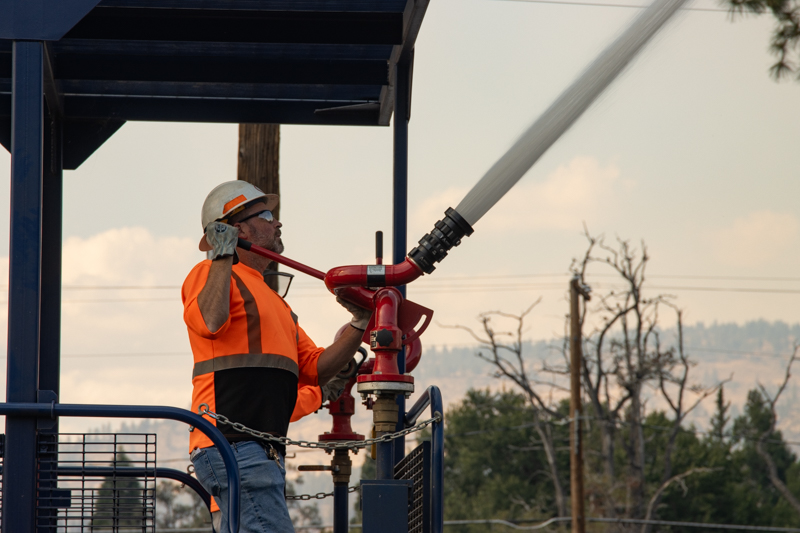
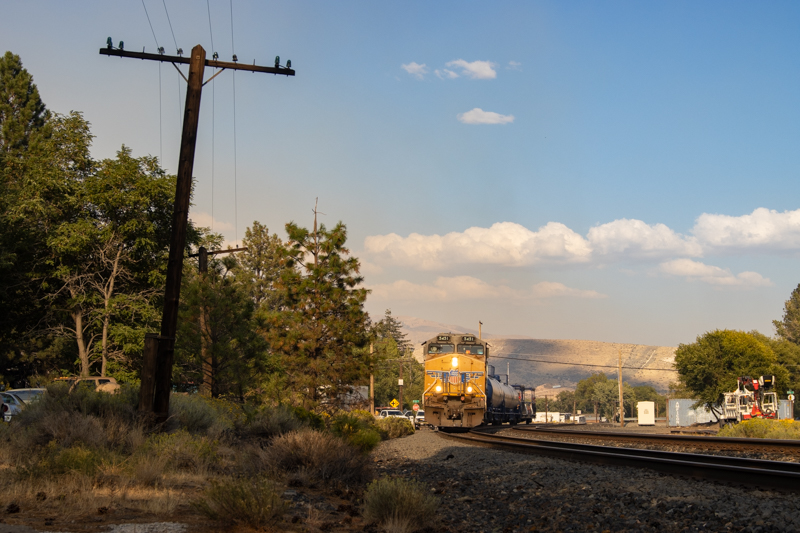
Crews use hoses on a UP fire train to douse the landscape arond the tracks as the Floriston Fire burned nearby. Photo by Nick Stewart.
The train was led by one locomotive and had three tank cars containing water, along with a platform car for a crew. The tank cars were outfitted with hoses and the platform car was equipped with cannons that allowed a crew to douse flames with water along the right-of-way.
As of Wednesday evening, the fire burned more than 600 acres and was five percent contained. Freight and passenger train traffic continued as normal while crews fought the fire.
UP sent another fire train up their former Western Pacific branch line north of Reno last month to help contain the Hawk Fire. —Nick Stewart
Freight and passenger train traffic continued as normal while crews fought the fire. Photo by Nick Stewart.
The post UP Sends Fire Train To Douse Flames On Donner appeared first on Railfan & Railroad Magazine.
‘Mohawk’ on the Move
New York Central L-3a 4-8-2 “Mohawk” 3001 left the National New York Central Museum in Elkhart, Ind., on September 15, bound for Fort Wayne, where it will be restored to service after decades on display.
The steam locomotive was being moved over Norfolk Southern rails behind that road’s NYC heritage unit, SD70ACe 1066. It was unclear when the locomotive would arrive in Fort Wayne.
The 3001 is the largest surviving NYC steam locomotive and the only member of the L-3a class to escape the scrapper’s torch. The locomotive was under the care of the City of Elkhart, Ind., and has been on display at the National New York Central Museum for decades. In October 2024, FWRHS launched an effort to restore the locomotive for use on its popular Indiana Rail Experience excursions.
FWRHS owns three other steam locomotives, most notably Nickel Plate Road 2-8-4 765, which it has operated since the 1970s. For the last few years, it has managed the Indiana Rail Experience, an excursion operation on the Indiana Northeastern Railroad, which has trackage in Indiana, Ohio and Michigan. Much of that track is former NYC, meaning locomotive 3001 will be right at home. NYC 3001 will also join the fleet of seven Budd streamlined cars built in 1941 for the NYC “Empire State Express” and purchased from Rochester & Genesee Valley Railroad Museum in 2023.
According to FWRHS, a mechanical evaluation of the locomotive has been performed by FMW Solutions with financial support from former Norfolk Southern CEO Wick Moorman. The group estimates that it will take $4.3 million to restore the locomotive to operation. Donations can be made online at AmericanLoco.org. FWRHS is also encouraging people to join its pledge list.
—Justin Franz
The post ‘Mohawk’ on the Move appeared first on Railfan & Railroad Magazine.
Alco: Sometimes Sentiment Wins
Why love a locomotive, much less a locomotive builder? For railfans, the answer is often simple. Sometimes it is the sheer look of an engine — its beauty, character, or unmistakable profile. Other times, affection grows from familiarity, when a locomotive seen in childhood becomes wrapped in nostalgia. And perhaps no diesel-electric builder inspires that kind of devotion more than American Locomotive Company.
Yet, to the accountants at railways across the continent, Alco was not a subject of much positive sentiment. After shutting down domestic production in 1969, the cost and availability of spare parts became a serious concern. Burlington Northern attempted to address the challenge by pooling both locomotives and parts to a single maintenance base, the former Spokane, Portland & Seattle terminal in Vancouver, Wash., eking out another decade of service in the process. Other roads were more direct — in the 1970s, Southern Pacific first demoted, then scrapped, its Alcos, while Union Pacific sold its off. In Canada, the Alco legacy was luckier, as affiliate Montreal Locomotive Works remained operating into the early-1980s, but this was only a delay in the familiar pattern of downgrades, storage, then sale or scrap.
Yet something curious happened; as the big railroads disposed of their Alco fleets, short lines and regional railroads began buying them. Certainly, their low purchase price compared with locomotives from builders still in business was attractive. But that advantage had to be weighed against dwindling parts supplies, increasingly specialized maintenance knowledge, and nonexistent factory support. So why keep buying Alcos?
It is often taken for granted that we the railfans are the sentimental ones, while those who work for the railways are likely to view their equipment — along with the rest of their industry — with a clearer head. Yet railroaders are also subject to sentimentality, and this, I think, explains this second and even third life for Alco locomotives.
Consider one example. When Atchison, Topeka & Santa Fe sold off several of its Alco PAs, four went to Delaware & Hudson to bolster its passenger service. When D&H changed course in the late 1970s, the locomotives were sold again, this time to Ferrocarriles Nacionales de México, where they worked former Southern Pacific de México routes.
At least one of them was repainted by FNM crews into Southern Pacific’s red and orange Daylight scheme. There was no strictly practical reason for doing so; it was an act of affection, and ex-D&H 17 became something of a mascot for railroad employees. It survives today, still wearing that employee-applied Daylight scheme, at the Museo Nacional de los Ferrocarriles Mexicanos in Puebla.
A stablemate, former Santa Fe 59L, eventually returned to the U.S. as little more than a shell and was brought back to life by preservationist Doyle McCormack. Today, it operates on Delaware-Lackawanna in Scranton, Pa.
Nobody at D&H was forced to buy those old Alco PAs, much less spend good money modernizing them and giving them a new lease on life. Nor did anyone at FNM have to purchase the locomotives third-hand, paint one in a fanciful Daylight scheme, or help keep them from the scrapper’s torch long enough to reach preservation.
All of this — and, for that matter, nearly every purchase of a used Alco since 1969 — suggests that the accountants do not always get the final word. Sometimes affection for a machine, however irrational it may seem, wins.
—Alexander Benjamin Craghead is a transportation historian, photographer, artist, and author.
This article appeared in the October 2026 issue of Railfan & Railroad. Subscribe Today!The post Alco: Sometimes Sentiment Wins appeared first on Railfan & Railroad Magazine.
Group Pulls Out of GN 4-6-2 Rebuild
The American Heartland Railroad Society announced on September 13 that it was pulling out of a partnership with the Sioux City Railroad Museum to restore Great Northern Railway H-5s 4-6-2 1355. In a press release, the group’s leadership offered few details about why it was leaving the project, except to say that the “situation has become untenable.”
“We believe it is in the best interest of our organization to step away from the project so that we can focus our time, resources, and energy on other important preservation efforts,” the press release read.
AHRS officials added that they would instead double down on other projects, including one to restore Union Pacific SD40-2 3593 to its “Desert Victory” livery and a Milwaukee Road covered hopper.
While AHRS is no longer involved, officials with the Sioux City Railroad Museum said they were moving forward with the restoration of 1355. The group has secured funding from the National Park Service and is still working with a contractor, RDG Steam Services, on the restoration.
Locomotive 1355 began life as a 4-6-0 in 1909 and was assigned to passenger service out of Spokane, Wash. In 1924, the locomotive was sent east to St. Paul, Minn., where the railroad rebuilt it as a 4-6-2, with a larger boiler, cylinders and firebox. The locomotive was designated an H-5s at that time. A year later, it was converted from being a coal burner to an oil burner. The locomotive was assigned to the Butte Division in Montana, where it led some of the GN’s finest passenger trains, including the Empire Builder and Oriental Limited. In 1950, the locomotive was sent to Minnesota to work in freight service before being retired in 1955. At about the same time, the community of Sioux City, Iowa, requested a locomotive from the GN for display. Locomotive 1355 was selected and sent south to Iowa, where it has been ever since.
—Justin Franz
The post Group Pulls Out of GN 4-6-2 Rebuild appeared first on Railfan & Railroad Magazine.
WRP Welcomes Nick Stewart to Staff of Railfan & Railroad
FOR IMMEDIATE RELEASE
September 14, 2026
White River Productions is pleased to announce that Nick Stewart has been named Associate Editor of Railfan & Railroad and Railroad Model Craftsman. A Nevada native, Nick is a 2026 graduate of the University of Nevada, Reno’s Reynolds School of Journalism. Before joining White River Productions, he worked as a photojournalist for The Nevada Independent and as a reporter for KUNR Public Radio in Reno. His work has appeared in national outlets including National Public Radio and the Associated Press. He is also a past contributing writer and photographer for Railfan & Railroad.
Nick developed an interest in railroading at an early age, and some of his earliest memories of trains are from visits to his mother’s office next to the Union Pacific yard in Sparks, Nev. He is a passionate railroad photographer with a particular interest in steam locomotives and vintage diesels. His favorite railroad is Southern Pacific, though he calls Western Pacific a close second. Nick dreams of building a model railroad one day — when he actually has the space — but for now he maintains a modest collection consisting primarily of 1980s and 1990s Southern Pacific diesels and rolling stock. He currently resides in Sparks with his family.
Nick joins the White River Productions staff full-time, working alongside Editor Steve Barry and Managing Editor Otto Vondrak on Railfan & Railroad and Railroad Model Craftsman.
Railfan & Railroad was launched in 1974 as Railfan, and expanded with the acquisition of the venerable Railroad Magazine in 1979. Railfan & Railroad is a showcase of modern trackside railroad action, with stunning photography paired with the latest industry news and monthly columns. Established in 1933, Railroad Model Craftsman delivers the best in scale model railroading each month. Every issue features beautiful layout tours, detailed scratchbuilding and detailing features, the latest news and in-depth product reviews, exact scale drawings, construction tips and techniques, and more. Both magazines were acquired by White River Productions in 2014.
The post WRP Welcomes Nick Stewart to Staff of Railfan & Railroad appeared first on Railfan & Railroad Magazine.
Short Lines, Class Is Ask for Trackage Rights in UP-NS Deal
Rival Class I railroads and a number of short line and regional operations intend to ask the U.S. Surface Transportation Board to grant them trackage rights to various parts of a combined Union Pacific-Norfolk Southern network if the federal regulator approves the proposed merger.
In a flurry of filings in early September, operators from BNSF Railway to the Wheeling & Lake Erie all announced their intentions to participate in the ongoing review of UP’s plan to acquire NS. While the filings did not need to detail how they would participate, many hinted at what they would ask in return for supporting the merger — or at least dropping opposition.
BNSF has been among the most vocal opponents of the merger and said in filings that its opposition will not change. However, if the board were inclined to let UP and NS merge, BNSF planned to ask for trackage rights east of Chicago into Pennsylvania on NS lines. Meanwhile, CPKC officials said they plan to ask the STB to protect its existing trackage rights on UP and NS and to grant new access, particularly between Kansas City and St. Louis. CSX was also planning to ask for rights into the Midwest.
Some of the most interesting proposals, however, came from several short lines. The Wheeling & Lake Erie announced it would ask for trackage rights over NS track to reach the Belt Railway Company of Chicago. The Reading & Northern, on the other hand, was asking for trackage rights south to Hagerstown, Md., in order to connect with CSX. Other short lines that have said they will ask for trackage rights include New Orleans Public Belt, the Columbus & Ohio, Indiana & Ohio, Chicago, Fort Wayne & Eastern, and others.
In August, the STB set a timeline to review the merger, suggesting the earliest it could be approved was sometime in the second half of 2027. If approved, the combined UP-NS would stretch more than 50,000 miles and touch 43 states. The merger was first proposed in mid-2025, but the STB rejected UP’s first application as “incomplete.”
—Justin Franz
The post Short Lines, Class Is Ask for Trackage Rights in UP-NS Deal appeared first on Railfan & Railroad Magazine.
Colorado Railroad Museum Acquires ‘Zephyr’ Dome
The Colorado Railroad Museum is acquiring a former California Zephyr dome car, a long-desired addition to the collection focusing on the history of railroading in the Centennial State. The Silver Rifle was built by Budd in 1948 for the Chicago, Burlington & Quincy, one of three railroads to operate the famed California Zephyr.
The car was previously part of the Golden Gate Railroad Museum collection and was on loan to the Western Pacific Railroad Museum in Portola, Calif., for many years. In early September, the car was sent east to Ohio for restoration, and once that is complete, it will go to Golden, Colo., for permanent display. The museum plans to restore the car to its as-delivered appearance, and its original mechanical systems will remain intact. The museum has not shared a completion timeline.
CRM is already home to the Dome Car Monument, a unique stone masonry arch originally erected in Colorado’s Glenwood Canyon near the site where an Electro- Motive Division general manager conceived the idea of the modern-day railroad dome car. A year after the streamlined California Zephyr’s 1949 debut, the Denver & Rio Grande Western, together with General Motors, came together to memorialize the dome car’s original idea by erecting this unique, stone monument along the train’s route. In the 1980s, the Dome Car Monument stood in the path of Interstate Highway 70 construction. It was carefully moved to CRM, where it remains on exhibit today.
The post Colorado Railroad Museum Acquires ‘Zephyr’ Dome appeared first on Railfan & Railroad Magazine.
VIA Rail Orders New Cars from Alstom
VIA Rail Canada has ordered 313 Adessia rail cars to replace its current long-distance passenger fleet. The $4.7 billion (Canadian) deal includes construction of the cars, as well as long-term technical support and spare parts services. The cars will be built in Canada.
The new single-level cars will include coaches, diners, sleepers and even dome cars. They will replace VIA’s present long-distance fleet, including its classic Budd-built cars purchased by Canadian Pacific back in the 1950s. The new cars will be used across the VIA Rail system, from Vancouver to Halifax.
The announcement of the Alstom order comes just weeks after VIA announced it was purchasing new locomotives from Stadler.
“These new rail cars will retain signature features such as dome cars, full-service dining and social areas, while incorporating modern amenities, improved accessibility, and greater reliability,” said VIA Rail Interim President and CEO Mathieu Paquette. “They will help us preserve essential services to remote communities and elevate the unique onboard experience that allows passengers to discover Canada in a way that only train travel can offer.”
—Justin Franz
The post VIA Rail Orders New Cars from Alstom appeared first on Railfan & Railroad Magazine.
Kettle Valley Reopens After Fire
A British Columbia excursion railroad has reopened after escaping a devastating wildfire that killed at least one person and destroyed an unknown number of structures over the summer.
The Bald Range Fire began on Aug. 7 near Summerland, B.C., home to the Kettle Valley Steam Railway. The fire has burned more than 50,000 acres and came concerningly close to the railroad’s station and shops. When the fire broke out on the afternoon of Aug. 7, railroad crews began moving equipment down the line and out of harm’s way, including its primary motive power, Canadian Pacific N2b 2-8-0 3716. The fire also forced the evacuation of tens of thousands of residents, so railroad employees were unable to access the shops and station area for a week. Finally, on Aug. 15, the railroad shared an update stating that its buildings and track had survived.
At the end of August, the railroad announced that regular excursion service would resume on Saturdays, Sundays, and Mondays beginning on September 5.
The Kettle Valley Steam Railway was founded in 1995 to provide excursions along the historic Kettle Valley Railway, a subsidiary of the Canadian Pacific that ran from 1915 until 1989. Locomotive 3716 was built by Montreal Locomotive Works in 1912 and worked in southeastern British Columbia for much of its career, including on the Kettle Valley. From 1975 until 2001, the engine was part of the BC Rail steam fleet, along with “Royal Hudson” H1e 4-6-4 2860.
—Railfan & Railroad Staff
The post Kettle Valley Reopens After Fire appeared first on Railfan & Railroad Magazine.
South Dakota Railroad Museum to Close
The South Dakota State Railroad Museum is closing this fall after the owner of the building decided not to renew the museum’s lease. Located alongside the Black Hills Central Railroad in Hill City, S.D., the museum has preserved the state’s railroad history since the 1990s.
The museum features a former Chicago & North Western caboose, as well as several exhibits and a paper archive. While the museum has occupied the space for years, the new owner of the Black Hills Central, World Choice Investments, has different plans for it. Museum officials said they are not disbanding and that their artifacts and exhibits will hopefully be displayed elsewhere. The museum is expected to close on October 16 and vacate the space by February 1, 2027.
—Justin Franz
The post South Dakota Railroad Museum to Close appeared first on Railfan & Railroad Magazine.
‘Mohawk’ To Leave Elkhart This Fall
New York Central L-3a 4-8-2 “Mohawk” 3001 is expected to depart Elkhart, Ind., this fall, bound for the Fort Wayne Railroad Historical Society shop in New Haven, Ind., where it will be returned to service. FWRHS and the National New York Central Railroad Museum plan on hosting a farewell event for the locomotive on September 4 and 5. The exact date for its move has not been set.
The 3001 is the largest surviving NYC steam locomotive and the only member of the L-3a class to escape the scrapper’s torch. The locomotive was under the care of the City of Elkhart, Ind., and has been on display at the National New York Central Museum for decades. In October 2024, FWRHS launched an effort to restore the locomotive for use on its popular Indiana Rail Experience excursions.
FWRHS owns three other steam locomotives, most notably Nickel Plate Road 2-8-4 765, which it has operated since the 1970s. For the last few years, it has managed the Indiana Rail Experience, an excursion operation on the Indiana Northeastern Railroad, which has trackage in Indiana, Ohio and Michigan. Much of that track is former NYC, meaning locomotive 3001 will be right at home. NYC 3001 will also join the fleet of seven Budd streamlined cars built in 1941 for the NYC “Empire State Express” and purchased from Rochester & Genesee Valley Railroad Museum in 2023.
According to FWRHS, a mechanical evaluation of the locomotive has been performed by FMW Solutions with financial support from former Norfolk Southern CEO Wick Moorman. The group estimates that it will take $4.3 million to restore the locomotive to operation. Donations can be made online at AmericanLoco.org. FWRHS is also encouraging people to join its pledge list.
—Justin Franz
The post ‘Mohawk’ To Leave Elkhart This Fall appeared first on Railfan & Railroad Magazine.
British Heritage Railway to Offer Commuter Service
Britain’s Severn Valley Railway is conducting an eight-week trial with a local passenger operator to provide steam-powered commuter rail service. The arrangement is believed to be one of the first of its kind in the U.K., with main line rail ticket holders traveling over part of their journey on a heritage railway, hauled by heritage locomotives and operated by heritage railway staff.
The Severn Valley is a 16-mile heritage railway that has provided steam-powered excursion service since the 1960s. The commuter service test, which will sometimes be powered by historic diesels, will operate on Tuesdays, Wednesdays and Thursdays. The service will connect with national network trains at Birmingham Snow Hill. There will be two morning departures and two evening departures. The service is expected to last until the end of October.
“This is a hugely exciting opportunity for the Severn Valley Railway. Not only does it allow us to support an important regional transport initiative, but it also sees our railway fulfilling the purpose it was originally built for by carrying everyday passengers between Bewdley and Kidderminster,” said SVR Chief Executive Officer Gus Dunster.
—Justin Franz
The post British Heritage Railway to Offer Commuter Service appeared first on Railfan & Railroad Magazine.
Pages